I guess I don’t have much “personal” stuff to write these days.
Go check out my work blog, my food blog, my photos, or follow my random musings on app.net or twitter.
Comments Off
Go check out my work blog, my food blog, my photos, or follow my random musings on app.net or twitter.
I kept seeing this pattern emerge, and couldn’t find a good name for it (originally in reference to failures of the free market), so I came up with one. Simply put, The Tragedy of the Selfish is the situation that exists when an individual makes what is logically the best decision to maximize their own position, but the sum effect of everybody making their best decisions is that everybody ends up worse off rather than better.
You buy an SUV, then other people do, because they want to be safer too. Except that if enough people make that same decision, you’ve overall raised the chances that if you’re hit by a car, it’ll be an SUV, which will do much more damage than a smaller car. Everyone is better off if everyone else backs off and drives smaller cars.
You buy a gun because other people have guns. Then other people do, because they want to be safer too. Then… you see where I’m going with this. Perhaps you’ve made yourself safer in some limited way, but you’ve decreased the overall safety of the system.
This is not safety, it’s mutually assured destruction.
I now feel compelled to share this, since many people have now discovered Jamie’s writing due to that whole thing. But for me, it started long ago with just a single link. Time melts away in an instant when viewing web pages meant to be rendered in Netscape, and now it’s hard to believe that was 16 years ago. It’s a real gem, and for me it was one of my first exposures to both effective use of hypertext (as opposed to theoretical academic use) and internet oversharing.
Start here. Click click click.
I backed the kickstarter project for coffee joulies, and my pack arrived yesterday. Initial reports have not been good. I used three of them this morning, in my normal Contigo West stainless mug, in lieu of the usual ice cube I normally drop in there to make it drinkable right away. The temperature change is definitely slight but noticeable. I use milk and no sugar. If I add no ice cube, it’s undrinkably hot for about 20 minutes. With an ice cube, it’s drinkable right away, and stays what I would still call hot for about an hour. With the joulies, it was still almost too hot to drink after a few minutes, but not quite too hot. Nearly three hours later, it’s still about at the temperature it’s usually at about a half an hour in.
More experimentation is warranted, but I think this is a thumbs up.
I can accept that DVDs are a dying business with no future growth and _escalating_ costs. I can accept that Netflix wants to get out of that business and move forward, even if the streaming product is still nascent and not competitive yet. I like Netflix, and I’ve been a loyal customer since before they had unlimited plans (I was the first person I knew to get a DVD player).
I accept that all of this might be necessary and painful to grow the business. But the thing is – it’s not our burden as customers to carry those costs, and it’s disingenuous to ask us to do so. The fact is, while DVDs are limited in growth, they’re still the better product with far more selection, and the DVD business you’re jettisoning is still profitable. If you want us to switch to a worse product that may be better in the future, great. Lower your prices to compensate. All of this brouhaha could have been avoided if you’d announced that everyone’s plan was a dollar per month cheaper until the streaming selection got better.
We’ll bear with you to make a difficult transition. Asking us to do so while giving us a worse experience and making us pay more for the privilege feels like taking advantage.
It’s not too late to change your mind.
I came up with this dish in response to a food question, and it sounded so good I had to make it the next night. It was promptly devoured by all present. It’s a great summer pasta dish.
Dice 2-3 heirloom tomatoes (or more), 3-4 avocados (or more), and 1 large onion.
Boil and salt 5-6 quarts of water for the pasta.
Heat a generous amount of olive oil in a medium frypan. Add the onion and sweat over medium-low heat until almost soft, then add half of the tomatoes and cook for about 2-3 minutes over medium heat. Add a generous sprinkle of salt and pepper. Meanwhile, cook a pound of fresh fettuccine.

Add 2-3 cloves of minced garlic, and half of the avocados, and heat through until softened.

Mince 3-4 tbsp. of cilantro, and add to a large bowl with the rest of the tomatoes and the avocados (not pictured).

When the pasta is done, reserve a half-cup of the water, then drain and return to the pot. Toss with the onion mixture and cook over low heat for 30 seconds until the pasta absorbs some of the oil. Put pasta into the bowl with the tomatoes and avocados, and toss. Sprinkle with 1-2 tsp lime juice. Add some of the reserved pasta water if it’s too thick (unlikely).

Top with parmesan and serve with a crusty semolina bread.
It’s vegan-friendly as is, but I think it would also be great with shrimp.
Someone on a list asked about influential food books of the past 10-20 years. Here’s my list:
The Omnivore’s Dilemma: A Natural History of Four Meals
Fast Food Nation: The Dark Side of the All-American Meal
This one is notable because it’s one of the first I’ve read that’s really well balanced with looking at balancing health, environmental impact, and worker welfare, but also taking into account taste and the fact that people really like to eat foreign foods:
On Food and Cooking: The Science and Lore of the Kitchen
Kitchen Confidential Updated Edition: Adventures in the Culinary Underbelly (P.S.)
The Making of a Chef: Mastering Heat at the Culinary Institute of America
Ratio: The Simple Codes Behind the Craft of Everyday Cooking
The Google+ Terms of Service include various provisions to give them license to display your content, and this has freaked out a bunch of professional photographers:
‘By submitting, posting or displaying the content you give Google a perpetual, irrevocable, worldwide, royalty-free, and non-exclusive license to reproduce, adapt, modify, translate, publish, publicly perform, publicly display and distribute any Content which you submit, post or display on or through, the Services.’
I don’t even understand why this is necessary. Why can’t this just be ‘you give us a license to display your content on the service until you delete it’?
Here’s an edit I did of the new “Food Plate” graphic. I think this is more accurate.

The NYT magazine ran this article on how sucrose is probably a poison that causes cancer and a whole raft of other ailments.
Unfortunately, the article is so poorly written and presents so little actual evidence that I’m shocked at the number of otherwise rational people who are simply taking it at face value. John Gruber, whose analysis I usually respect, writes “It’s not often that a magazine article inspires me to change my life. This is one.“.
Here are a few specific comments:
Excess sugar is clearly bad. I accept that it’s probably even worse than excess fat. I don’t see even a small shred of evidence to accept the logical leap presented in this article that eating a cookie will increase your cancer risk in any meaningful way. Absolutely, we need to study this more. Concluding that sugar is toxic in normal quantities based on the available evidence is ridiculous. Despite the indecision in the article, it’s not hard to define “normal quantities”. I’m the first to agree that the current “sugar in everything” trend in packaged food is bad, and it’s important to check the nutritional labels. HFCS has no business being in bread. The brands you grew up with are not indicators of quality. In fact, I’d go so far as to say that if your food has a nutritional label at all, you’re already at a disadvantage.
Eat more whole foods. Stop taking your calories in liquid form. Cooking at home is different. Change your food chain.
A few years ago, I decided to eat a salad for lunch at least 5 days a week. It’s a great way to make sure you get a lot of vegetables, and if you do it right, it’s very satisfying. I didn’t want to do Bittman’s “vegan before 6pm” diet, but this is a similar approach. It also takes a lot of the guesswork out of what I’ll have for lunch on any given day. I usually make my own. If you’re on the go, Fit & Fresh makes a very convenient shaker container with a dressing compartment and a removable ice pack.
For me, a salad is at minimum: a green leafy vegetable (lettuce or spinach), cucumber, some sort of tomato, and dressing. Everything else is optional, but I try to mix in at least one ingredient from the following categories. The key is getting a range of interlocking textures and complementary flavors. Buy the best ingredients you can find.
Lettuce: I usually use a heartier crunchy lettuce (romaine) or a greens mix. Local greens are always preferable, and you can still find farmers who do greenhouse greens in the winter. People will tell you not to cut lettuce but to tear it up with your hands. I don’t find that it makes a difference either way. Always rinse lettuce a few times in a salad spinner and then soak it in very cold water for 5-10 minutes before drying and using it. Unwashed lettuce will usually last about a week in the fridge if it’s fresh. Washed lettuce may last 2-3 days – store it in an airtight container with a folded paper towel to absorb excess moisture. If there isn’t good lettuce to be found, baby spinach makes a nice alternative. You can wash grape or cherry tomatoes with the lettuce.
Cucumber: Local is always better. Generally, the smaller varieties will have more flavor and crunch – I usually use kirbys or small pickling cucumbers. Peel any cucumbers that have been shipped loose – they’re coated with a paraffin layer to protect them.
Tomato: If local tomatoes are in season, use the big ones, preferably heirlooms. They’ll dominate the salad, and when they’re in season that’s probably fine. Otherwise, tomatoes for salad should always be the smaller cherry or grape tomatoes. Out of peak season, these are the only ones that are tolerable, and they get less so as the winter wears on. I usually include them anyway for some color and texture.
Other vegetables: Depending on my mood, I’ll include some diced red, orange or yellow pepper (but almost never green – I’m not that fond of bitter flavors). Cooked beets add a nice sweetness if you like them. Shredded carrots can be nice, but I usually find their flavor too strong. To the detriment of my breath, I’ve been cursed with whatever Eastern European gene causes me to crave raw red onions, especially in the winter. In the summer, I like to use raw local corn.
Animal Protein: I often omit the animal proteins for side salads, but without them it doesn’t really feel like a meal, so I always include at least one in my lunch salads – a hard boiled egg (use eggs that are 2-4 weeks old, start in cold water, bring to a boil, cover, let sit for 8-9 mins, shock in ice water), crumbled bacon, diced leftover chicken or steak, or a few cooked shrimp (thaw frozen shrimp in water, then boil for 3 minutes and shock in ice water).
Fruit: In the summer, this will be a sliced peach or plum, in the fall it’ll be apple or pear. Dried fruits work well – raisins or cranberries. Raisins pair well with honey mustard dressing and bright vinaigrettes, cranberries go better with creamy dressings.
Cheese: I usually avoid cheese, but I have a periodic craving for the combination of blue cheese, roasted garlic vinaigrette, beets, and nuts. I think most cheese doesn’t mix well with dressing, but there are a few combinations that work.
Dressing: My favorite dressing of all time is Brianna’s Poppy Seed Dressing. It’s creamy and thick, and goes with just about everything, and is the exception to my belief that most bottled dressings aren’t very good. I also like some varieties of honey mustard, or I’ll make a vinaigrette. In the summer, I like to make a vinaigrette with a bold raspberry vinegar. Use whatever you like. I’d avoid lowfat dressings, because they generally don’t taste very good. You’re eating a salad instead of a chalupa! You can have a little fat.
Crunch: I like to include at least one crunchy element – croutons or slightly toasted (300F for 6-8 mins) walnuts or pecans. If you buy croutons instead of making your own, look for those without HFCS.
A few suggestions:
My standard winter salad: romaine lettuce, persian pickling cucumbers, grape tomatoes, sliced red onion, diced cold chicken/bacon/hardboiled egg, croutons, dried cranberries, poppy dressing.
My alternate salad: mixed green lettuce, cucumbers, tomatoes, red onion, shrimp, crumbled bacon, diced beets, croutons, plus either raisins and honey mustard dressing or crumbled blue cheese and roasted garlic vinaigrette.
My favorite summer salad: mixed green/red lettuce, cucumbers, heirloom tomatoes, sliced red onion, sliced cold skirt/flank steak, raw corn, sliced peaches, croutons, poppy dressing.
Suggest some of your favorites in the comments or on twitter.
“Jim was monstrous proud about it, and he got so he wouldn’t hardly notice the other dudes. Dudes would come miles to hear Jim tell about it, and he was more looked up to than any dude in that country. Strange dudes would stand with their mouths open and look him all over, same as if he was a wonder. Dudes is always talking about witches in the dark by the kitchen fire; but whenever one was talking and letting on to know all about such things, Jim would happen in and say, ‘Hm! What you know ’bout witches?’ and that dude was corked up and had to take a back seat.”
Sous Vide eggs are tricky, because the yolk sets at a lower temperature than the white. If you cook a whole egg in the shell, you either get a properly cooked yolk with a runny and gelatinous white (some people like this, some think it’s like eating a ball of snot), or you get a properly set white with a really overcooked yolk. As far as I can tell, it’s not possible to get a perfect “poached egg” with the sous vide method, if you cook the egg whole in the shell.
To deal with this, I separated them and cooked them individually at two different temperatures. You can cook the white first at a higher temperature to just set it (160-162F or so, depending on how firm you like it), and then lower the temperature (to 144F or so) and add the yolk. To make this a little more convenient, you can even do the white in advance, chill it, and keep it and the separate yolk in the fridge overnight, then add the yolk and cook them in the morning. The white takes about 60-90 minutes to set (depending on whether you start from fridge or room temperature), and then the yolk takes about another 60-90 minutes. Cooking the yolk will also bring the white back up to serving temperature without overcooking it. It’s not quite fast enough for a rushed morning, but that’s acceptable timing for a lazy morning.
I tried leaving them in the water overnight at 144F, and that didn’t work – the yolks got completely overcooked and gummy. There might be a lower temperature at which that would work. Even still, unlike with regular poached eggs, there’s very little fuss. This method takes longer, but it doesn’t require you to do anything while it’s cooking.
As I looked around for a proper vessel to cook them in, I found something I’d dabbled with but never really gotten good results with, which in retrospect is actually pretty perfect for sous vide cooking: an egg coddler.

Yes, you can use your hands to separate eggs, but I wanted to be extra careful not to break the yolk membrane. I put the yolks in a covered bowl in the fridge while the white cooked.

Here you can see the thin layer of undercooked white that was left over with the yolks, and the more properly cooked white layer underneath:

You can serve it directly out of the coddler, or turn it out into a bowl:

Here you can see how perfectly runny the yolk is, and the white is creamy and well set:

This is a great poached egg. I’m not sure it’s that much easier or more convenient than regular poached eggs in terms of timing, but it certainly requires less effort for excellent and tasty results. I think this is probably overkill if you’re just cooking for one (the above was an experiment and I didn’t want to ruin a lot of eggs if it didn’t work out), but it would work just as well with a dozen or more. Doing a single poached egg isn’t that much effort, but doing a lot of them can add up. I also got very good results using a small Le Creuset ceramic crock with a lid, though that can’t be submerged in the same way that the egg coddler can. If you want to use something like that, you’ll need a rack to keep it near the top of the water level.
I’ve found that this silicone rack is the perfect size for the SVS. You’ll need two of them for a short crock/ramekin.
After a great success with scrambled eggs, I wondered if it would be possible to make french toast in the SVS. I’ve had some good results with french toast the regular way, but it requires a lot of advance planning, and I find it difficult to ensure that the egg mixture gets absorbed and cooked all the way through without making it soggy in the middle.
I whipped up 8 eggs, added about 3/4 cup of milk, a splash of vanilla, and a pinch of salt. I added this to two slices of homemade challah in a ziploc vacuum bag and sealed it. I then shook the bag to distribute the liquid evenly and sucked the air out with the pump. These bags are much easier than the Foodsaver bags when you’re dealing with liquids, because you don’t have to worry about the seal getting gunked up.
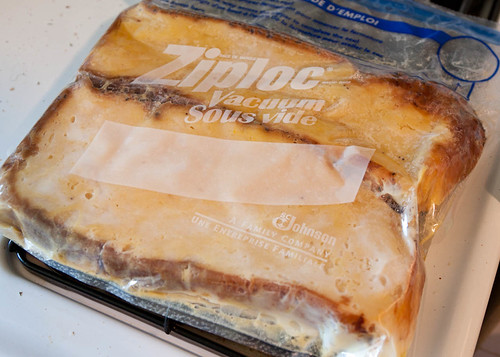
I then cooked them in the SVS for an hour and a half at 147F, removed them from the bag, and put them in a hot skillet with a little butter to brown the outside on both sides.


They came out perfectly – slightly crispy on the outside, and evenly cooked throughout, with a wonderfully creamy yet substantial texture.

Drawing on some inspiration in this post on creme brulee at SVKitchen, I decided to try a custard. Since I bought entirely too many blueberries this season, and the last of the bunch is rapidly aging in my fridge as I try to use them up before they go bad (I’ve already frozen as many as my freezer can handle), I decided to top this batch with a blueberry gel.
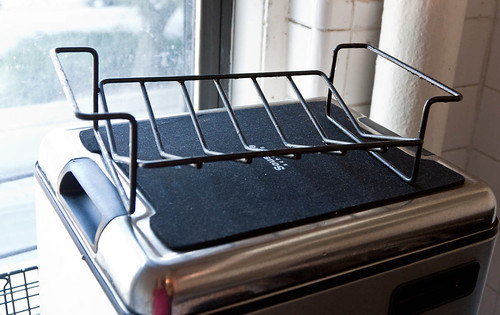
The SVKitchen folks used a set of fiberglass rods to elevate the tray to allow the custard cups to sit near the top of the oven while maintaining the proper water level, but it turns out that one of my cooking racks fit perfectly underneath the included one:



The normal way to make custard is to cook the cream and sugar at a moderate heat together to mix them, and then add beaten eggs and cook in a water bath. I thought the SVS could make this easier, so I just mixed all of the ingredients together in the mixer until they were combined but not frothy (do the last little bit by hand for more control). I doubled Bittman’s standard custard recipe (I’ve pretty much given up on the book and use his $2 searchable iPhone app all the time) and substituted vanilla for the nutmeg and cinnamon, since I’m allergic to nutmeg and I like vanilla. This doubled recipe calls for 4 cups of cream, 1 cup of sugar, 4 whole eggs, 4 egg yolks, and a pinch of salt plus flavorings:

This recipe made enough to fill 8 8-oz ramekins all the way to the top, plus a little left over. I filled the cups through a mesh strainer to get out any last unmixed bits, covered them with plastic wrap, and cooked them (covered) in the SVS at 175F for an hour:

When they were almost done, I cooked about two cups of blueberries over moderate heat with a tablespoon or so of sugar and bloomed a packet of gelatin in a bowl of water. When the blueberries were cooked through and starting to burst (about 5-7 minutes), I stirred in the gelatin and let them cook for a few more minutes. Then I drizzled the hot syrup over the top of the cups:

After chilling in the fridge for about 4 hours, they were absolutely fantastic. The texture is flawless, the flavors are great, they’re perfectly cooked all the way through, and the whole thing only took about 15-20 minutes of actual effort.

Lovely.
The following is a catalog of my somewhat unscientific objections to High Fructose Corn Syrup (HFCS), across a number of different axes:
Proponents of HFCS claim that it’s “just like sugar”, but that’s not strictly true. Even the form of HFCS that’s closest in chemical formulation to sucrose is 55% fructose and 45% glucose, which is a liquid at room temperature. Fructose metabolism behaves differently in the absence of glucose, and in practice that ratio seems like enough to tip the scales in that direction.
HFCS is a mixture, not a compound. In the case of sucrose, it’s a very weak bond between the fructose and the glucose, but there is a bond there that can be used to regulate the rate at which it’s metabolized (cleavage of the disaccharide into glucose and fructose happens in the small intestine). When you eat HFCS, you just dump a bunch of fructose and glucose on your metabolism all at once, to be absorbed as quickly as possible. I haven’t seen any research examining whether this is a problem or not, but it seems like it would be.
There is an increasing body of research pointing to excess fructose or HFCS specifically as being responsible for weight gain, raising bad cholesterol levels (see the Personal Experience section at the end) and causing cancers to grow faster.
I don’t know of any research examining whether the fructose in fruit or agave syrup has similar effects. My guess would be that the fructose in fruit is buffered by everything else in the fruit (see the coda on nutritionism at the end) and that agave syrup is probably not great for you either, but I have no evidence to support either of those assertions.
I don’t like the way HFCS tastes – I find that foods sweetened with it have a somewhat sickly flavor, and a lingering unpleasant aftertaste.
Companies that put HFCS in their food do so because it’s cheaper than sugar, not because it’s better than sugar. A few cents extra per loaf of bread makes a huge difference when you’re selling a few million loaves, and it makes a lot less difference when you’re buying one loaf. I try to make as much of my food from ingredients I personally choose, but when I have to buy packaged food, I generally want it to be as good as it can be. In my experience, foods that avoid HFCS also tend to use better ingredients and have better overall quality. I’m disgusted by how difficult it is to find food in the supermarket that doesn’t contain it.
HFCS is an industrial byproduct of corn subsidies. This is a very deep subject with a large number of complex interactions, but one thing is pretty clear — the aggregation of incentives for many farmers line up to cause them to grow lots of corn (and soybeans) to the detriment of other products. Monocultures in farming are generally problematic, and I think we should be encouraging more biodiversity instead of less. Vastly simplified, the government makes it financially attractive for a large number of farmers to grow very few varieties of corn with the use of petrochemical fertilizers and pesticides. This increases our dependence on foreign oil, it weakens the basis of our foodstocks, and it gives us a large number of very cheap byproducts that make their way into everything. Michael Pollan has given this subject far more exploration than I could – I highly recommend reading the chapter on corn in The Omnivore’s Dilemma (or the article on which that chapter was based).
Sometime over the summer of 2008, I made the personal decision to eradicate as much HFCS as possible from my diet. I would no longer voluntarily buy any processed food containing HFCS, and I would make conscious attempts to avoid it. I had my cholesterol checked in June, before I started this experiment, and again in December. During that time period, with no other lifestyle changes, my Triglyceride count dropped by 39 points and my LDL count dropped by 28 points. I attribute this change entirely to the direct and indirect effects of cutting out HFCS – cutting out HFCS itself, cutting out the other processed ingredients that often go along with it, and decreasing my consumption of processed food overall. In actuality, HFCS itself may be entirely benign (though I see little evidence of that), but I feel that removing it from my diet was an unqualified net good. Unfortunately, it’s been impossible to remove entirely, as most restaurants use it. As a result, I’ve been trying to cook at home more (with a little help), which has also been largely a net good.
Michael Pollan makes a really good point about eating whole foods in In Defense of Food (and the essay on which it was based). The whole essay is worth reading, but this section stood out for me:
Also, people don’t eat nutrients, they eat foods, and foods can behave very differently than the nutrients they contain. Researchers have long believed, based on epidemiological comparisons of different populations, that a diet high in fruits and vegetables confers some protection against cancer. So naturally they ask, What nutrients in those plant foods are responsible for that effect? One hypothesis is that the antioxidants in fresh produce — compounds like beta carotene, lycopene, vitamin E, etc. — are the X factor. It makes good sense: these molecules (which plants produce to protect themselves from the highly reactive oxygen atoms produced in photosynthesis) vanquish the free radicals in our bodies, which can damage DNA and initiate cancers. At least that’s how it seems to work in the test tube. Yet as soon as you remove these useful molecules from the context of the whole foods they’re found in, as we’ve done in creating antioxidant supplements, they don’t work at all. Indeed, in the case of beta carotene ingested as a supplement, scientists have discovered that it actually increases the risk of certain cancers. Big oops.
What’s going on here? We don’t know. It could be the vagaries of human digestion. Maybe the fiber (or some other component) in a carrot protects the antioxidant molecules from destruction by stomach acids early in the digestive process. Or it could be that we isolated the wrong antioxidant. Beta is just one of a whole slew of carotenes found in common vegetables; maybe we focused on the wrong one. Or maybe beta carotene works as an antioxidant only in concert with some other plant chemical or process; under other circumstances, it may behave as a pro-oxidant.
Indeed, to look at the chemical composition of any common food plant is to realize just how much complexity lurks within it. Here’s a list of just the antioxidants that have been identified in garden-variety thyme:4-Terpineol, alanine, anethole, apigenin, ascorbic acid, beta carotene, caffeic acid, camphene, carvacrol, chlorogenic acid, chrysoeriol, eriodictyol, eugenol, ferulic acid, gallic acid, gamma-terpinene isochlorogenic acid, isoeugenol, isothymonin, kaempferol, labiatic acid, lauric acid, linalyl acetate, luteolin, methionine, myrcene, myristic acid, naringenin, oleanolic acid, p-coumoric acid, p-hydroxy-benzoic acid, palmitic acid, rosmarinic acid, selenium, tannin, thymol, tryptophan, ursolic acid, vanillic acid.
This is what you’re ingesting when you eat food flavored with thyme. Some of these chemicals are broken down by your digestion, but others are going on to do undetermined things to your body: turning some gene’s expression on or off, perhaps, or heading off a free radical before it disturbs a strand of DNA deep in some cell. It would be great to know how this all works, but in the meantime we can enjoy thyme in the knowledge that it probably doesn’t do any harm (since people have been eating it forever) and that it may actually do some good (since people have been eating it forever) and that even if it does nothing, we like the way it tastes.
I think that about covers it. I welcome comments.
I couldn’t find a recipe for making dried beans sous vide for my Sous Vide Supreme, so I winged it. It worked really well.
1 cup dried black beans, rinsed 1 diced medium red onion Roughly the same volume of beans in ice cubes
Preheat SVS to 180F. Seal all ingredients in a vacuum bag.
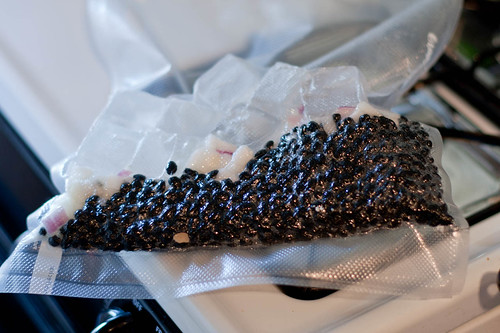
Cook for 36 hours. After 24 hours, I squeezed the bag and it still felt a little firm, so I put them back in. The beans were completely tender all the way through, but not squishy and had a really pleasant texture. Salt to taste before serving.

Since I last wrote about cooking at home, I’ve been looking for more ways to try to cook at home. Cooking large portions in advance helps, but I think it’s somewhat unsatisfying to eat that way on a regular basis. Those foods that can be more easily prepared beforehand tend to be heavier and less appealing during the summer – lasagnas or casseroles or big braises. I’ve recently acquired a Sous Vide Supreme oven, and it’s completely changing the way I look at this.
Sous vide cooking is actually pretty simple – you seal the food in a vacuum bag (like a Foodsaver bag) and then cook it in a precise temperature water bath at very close to the temperature you want the final product to be. If you’ve eaten in a high end restaurant in the past few years, you’ve had food cooked sous vide – almost all of them are using it now, with good reason. When the food is done (at minimum, enough time for the middle to reach the equilibrium temperature), you take it out of the bag, sear it in a hot pan if needed (most proteins will benefit from a little browning to develop more flavor, but they really only need about 30 seconds per side in a very hot pan on the stove), and serve it right away. If you leave it in the water bath for a few extra hours, it’s no problem – the texture of some food will break down after an extended period of time, but for the most part, it’s hard to overcook things (fish and eggs are two exceptions – they’re more finicky about timing, but that still buys you a margin of an hour or two over). Because you can set the oven at 1 degree increments and it will stay at pretty much exactly that temperature, you can get exquisite results with very little effort, and if you get distracted, it’s no problem.
There are a few issues with trying to get dinner on the table with small children in the house, and these problems are triply compounded with only one parent in the house – you can get distracted by having to change a diaper or give one of the kids a little extra attention. Right before dinner is crankypants time. The kids might want to stay out at the park for an extra half an hour or 45 minutes. You might want to stay out at the park for an extra half hour or 45 minutes. There goes your prep time. Watching a chicken breast or a steak cook on the stove for 15-20 minutes with a small child is far too long (and takes away from the time to cook the rest of the meal), but searing for a minute or two while everything else comes together is completely doable. What’s even better is that you can do the sous vide step the day before, plop the bag right into an ice bath, and then put it in the fridge until dinner time, when you just have to take it out and sear it or warm it. What’s even better than that is that you can put the bag in the sous vide oven directly from the freezer. And what’s even better than that is that this entire process actually makes your end result tastier and more nutritious instead of compromising quality. Commercial frozen convenience food is generally pretty terrible. Sous vide food is simply… better.
My wife and I both work long hours, and getting dinner on the table can be a challenge. Often, our window for doing so may be as little as 15-20 minutes from the time we walk in the door, otherwise the kids will start to get hungry and have a hard time settling down to eat. In the past year, we’ve missed that window more often than I’d like, and if we have a half an hour or more of cooking ahead of us, we’ll usually end up ordering instead. In addition to being less healthy overall, this can cost us around $30-$40 per meal over the cost of what we would have paid for ingredients for dinner, even buying top quality ingredients at the farmer’s market. At $450, the Sous Vide Supreme is pricey, but if it can prevent us from ordering out even once a week, it will literally pay for itself in four months. We’ve already used it five times in the first week. Time will tell if this is a novelty effect, but so far I’ve been overwhelmingly thrilled with the results. There’s been a lot of focus on 30 minute meals, but for a busy working parent or two, that can be an eternity. I love to cook, but even after years of practice, my timing isn’t perfect. Pair the Sous Vide Supreme with a rice cooker with a timer and a microwave vegetable steamer and it becomes possible to get a completely freshly cooked dinner on the table with minimal work in less than ten minutes. Even without going to that extreme, it significantly cuts the amount of stove time required for a “regular” meal.
Sous vide cooking certainly requires some planning ahead – it’s not for quick dinners unless you start early, but you don’t have to really figure out how early to start – putting the bag in before you leave in the morning is just fine. It’s also a huge psychological boost, because when you get home, dinner’s already on the way to being cooked. When all you want to do is sit down after a long day and the kids are hungry, it really helps to have things already started.
We’ve done chicken breasts, steak, 30 hour country style pork ribs, carrots in butter – all pretty perfect. Soft boiled eggs and pork chops deserve special mention. Eggs do completely different things in sous vide, because the yolk actually cooks at a lower temperature than the white, and so it cooks first. A soft boiled egg in sous vide gets you a creamy but cooked yolk and a runny white. It’s strange, but entirely delicious. Hard boiled eggs were a little off, because cooking at a high enough temperature to set the white actually overcooks the yolk a little bit. I prefer 8 minutes in water just off the boil. Big fat scallops came out intensely creamy and tender.
And then, there are the pork chops. I’ve struggled for years to get a perfectly cooked pork chop. I’ve tried pan frying, broiling, baking, and braising, and nothing works reliably. They’re just too lean and too thin. They overcook before the outside starts to brown. With sous vide, they’re just right, every time, with almost no effort. They’re cooked all the way through, but not overcooked, and they’re so tender that you can cut them with a fork.
The oven comes with a few recipes with common timings, but there’s little news there if you know what your target temperatures are for regular cooking – steak at 130F, pork chops at 135F, chicken at 142F, fish at 140F, etc… There is no shortage of recipes on various food blogs, and this is a very good intro guide, though it seems meant for a more industrial setting. There are some extra safety considerations, but it’s mostly just common sense, and much of it doesn’t come into play in a home setting where you’re not storing the bags for long periods of time. You just have to be careful that you’re dealing with a somewhat anaerobic environment that can breed microbes that usually aren’t a problem in home kitchens. As long as you’re buying quality food, treating it with respect (understanding the rules of heating, chilling, and storage), and eating it promptly, you shouldn’t have any problems.
In short, this device is amazing, and it’s the future. For me, it fulfills every convenience promise of the microwave and the crock pot, neither of which I’ve ever been happy with from a culinary perspective. There is a small consideration of the extra waste in plastic bags, but I balance that against the amount of waste generated from takeout, which is far greater.
I can’t recommend it enough.
There’s a bit of a debate going on about whether the lack of cooking at home is responsible for people eating unhealthily. Matt Yglesias has a piece arguing that cooking at home isn’t fundamentally different from restaurant cooking, and “If someone – Jamie Oliver, for example – devised an appealing mass-market food product that was better than Taco Bell on the taste/price/convenience dimension but also healthier, well that would be an excellent thing for the world.” Well, it sure would. It would be nice if someone could make a car that drives like a BMW but doesn’t use any gas and costs less than $1000 too.
http://yglesias.thinkprogress.org/archives/2009/10/what-the-world-needs-from-its-celebrity-chefs.php
“Cooking yourself” is not the point. “Cooking at home” is. This is because home cooking is different from restaurant cooking, and yes, there is a fundamental difference between food you prepare for yourself and food prepared by other people, at least when the latter is in a commercial/restaurant context. Unless you have a private chef, food prepared for you by other people is food prepared for… whomever. This difference is largest at scale. Industrial food is the way it is because it’s designed to be made/prepared/”made” by people with no skill at cooking for a clientele who may show up at any time and want what they want, and when you do that, you lose all kinds of properties of the food that go into making it healthier. You lose varietal selection. You lose focus on balance. You lose accounting for individual tastes. You lose someone insisting that you eat your vegetables (both because they’re good for you and also because whoever cooked them put a lot of effort into making them for you). You lose incentive to not use cheaper ingredients (or at least you divorce yourself from that decision). You lose incentive to not use flavor boosters that are unhealthy. You lose the ability to make food on demand, so there’s incentive to use ingredients that will store better. Fine cuisine doesn’t fare much better, because it’s not optimized for health, but for flavor and pleasure.
Healthy food has a lot of properties that are, I think, inherently unscalable. Saying that restaurants should offer cheap healthy options is not understanding the problem. Yes, cooking at home is a lot of work, and sometimes that takes away from the time you could be using to watch a movie or read a blog, but the benefits are immense, and they won’t realistically ever come out of a restaurant. Is that really such a bad thing?
“I have purchased a number of household appliances, more than a few of them made by the Dyson corporation, and never have I been so embarrassed about any of them as I am about this Dyson DC16. I am embarrassed for myself that I didn’t immediately return this unit after trying it out the first time, instead giving you the benefit of the doubt. I am embarrassed for you that you produced it and sold it as a functional appliance, sullying the reliability of your brand.
During the first year I had this handheld vac, never once did a full charge of the battery last more than 5 minutes. When it got down to less than 3 minutes, I spoke to your support representatives, who told me that the charger was probably defective, and sent me a new one. That helped for a short period of time, and I lived with it.
However, I’ve reconsidered. I no longer want to own this device. Its complete inadequacy at the task for which it was designed plagues me, and I am sufficiently disgusted with it that I cannot bear to pass it on to someone else. Nor am I willing to just throw it in the garbage – it is not worthy to even contribute to landfill somewhere.
I am therefore left with no choice but to return it to you. Please do as you see fit.”
We used to have a 6-at-a-time Netflix plan. We’d get 6 movies, but then sometimes we’d go months before watching them, or even just deciding that enough was enough and sending them back. And frequently, even among those 6 movies, there would be nothing we wanted to watch on any given night. And then an interesting thing happened. As part of a general cost trimming in our house, we dropped down to a 3-at-a-time plan. And suddenly we started watching a lot more Netflix movies. With 6 movies to choose from, there was always “something else” to watch, and we didn’t have to worry about clearing out all of the cruft to make room for something we really wanted to watch. As a result, we didn’t think as carefully about whether we’d really want to watch a new movie, because just renting something wouldn’t really block something else that we wanted to see more if it came along. But when we introduced a little artificial scarcity into the mix, a slot became something worth protecting from something we didn’t really want to see, and we started thinking more about which movies to put to the top of the queue, and then actually being more aggressive about watching them and sending them back.
This seems like a strange effect to me – we’re paying less, we’re technically using less (3 out instead of 6 out), but we’re turning over more, so the net effect is probably that we’re heavier users now than at 6-out. Because the pricing is only on the number out instead of the turnover, we’re unarguably paying less and using more, even though we’re technically on a “lower usage” plan. At this point, even if we wanted to spend the extra money, I have no desire to go back to a 6-out plan, because I like the extra sense of urgency that comes from having the out slots be a scarce resource, and it makes me want to use the service more.
I don’t know if this makes me a better Netflix customer or not, from their perspective. Obviously I’m paying less money to them per month and using more in mailing fees, but I’m also holding onto premium movies for a lot less time than I used to, freeing them up to be sent to other customers.
Anyone notice the same thing?
First, I loved it. I think it was the best movie I’ve seen in a long time. It treated the source material with respect, but established its own direction. The casting was basically flawless, and each of the major characters settled into their respective roles as gracefully as putting on a new pair of shoes from the same brand in the same size you were wearing before. The IMAX version is huge, but sit back more than you think you need to. We ended up being a little too close and it was sometimes hard to focus on the fast action scenes.
Spoilers ahead.
I loved the new bridge, and I was completely wowed at the omnipresent reflections and lens flares going on in the foreground. It really added the sense of being there and catching light bouncing off of some shiny panel, of which there are now many. Similarly, I loved the scope of the new engineering. Finally… it looks big.
All of the performances were grand and Zachary Quinto was impressive as a young Spock, but I think Karl Urban gets a special callout for really nailing the crotchety Bones. (And he was shafted a special commendation for saving the entire universe by sneaking Kirk on the Enterprise in the first place.)
I thought the time travel execution was very successful, and I very much liked that they didn’t take the standard “everything gets resolved at the end of the episode” tack and left things messy instead. The seamless shift into what otherwise would have been a reboot or a lifeless prequel… completely works for me. This is a different universe, most notably in the way that six billion Vulcans are now missing. As the Vulcans are the main ambassadors of the Federation for first contact, this has drastic implications on the influence and power of the Federation. But, as a mitigating factor, Spock is back from the future with 130 years of accumulated knowledge. Vulcans have essentially photographic memories and the ability to share thoughts widely without having to explain them, and Spock apparently doesn’t seem shy about applying this where necessary to rebalance things. And it’s not just technological knowledge – he’s one of the most well-versed people ever in galactic politics. He knows where all of the hidden enemies and backstabbing and power grabs are going to come from, he knows which alliances are likely to form, and he knows which resources people are going to be fighting about. This is a unique position – he can prepare the Federation in advance to deal with all of these threats before they fully manifest. As time goes on and the timelines diverge, his knowledge will become less useful, but should still provide the Federation with a significant advantage in the short run, enough to make up for the lack of influcence of most of the Vulcans (and they’ll still have the thousands who survived to carry on at least some of the legacy).
Going forward, this is a very different universe, and I very much look forward to seeing how it unfolds. I hope they consider returning to a serial format, though not necessarily TV. There’s way too much rich material to mine here now to only tease us with a single movie every few years, and I think it would be a waste of this potential to fully focus on the action stories which the movies tend to favor (which is not to say that they’re not a ton of fun). But for the first time in a long time, I need to go see it in the theater again.
It just doesn’t look like a very good movie to me. I didn’t like 300 terribly much. It was visually accurate with the book, but I found it fairly boring for most of the way through. I’m tired of ILM demo reels masquerading as masterwork films. The actors, with the exception of Silk Spectre, all seem about 10-15 years too young, and far too shiny. Watchmen is not supposed to be a shiny movie, except in very specific parts. Also, by and large, it’s not an action movie, again except in very specific parts.
The goal of “I’m doing this so someone else won’t fuck it up worse” is laudable, but ultimately flawed.
I expect it’s going to be a lot like the Hitchhiker’s Guide movie – visually accurate but stripped of everything great except glancing references to everything great in the book. I don’t really need a reminder to go read the book again.
One of the most striking moments of the book is when you realize that even the visual panel structure in issue 5 is symmetrical around the assassination attempt on Veidt and is flanked on both sides by about eighty thousand important plot elements that have been carefully arranged for you, by hand, in advance. That is when you realize that what you’re holding in your hands is really something special. It can’t be done as a movie, because it’s not something that can make its impact when it just flashes by. You have to sit there and stare at the page, and flip back and forth, and let it sink in, and sometimes take a few minutes to just absorb everything in one panel.
I’m guessing… not. Maybe I’ll see it eventually, but not tonight.
BoingBoing reports that new rules on consumer safety threaten to put small producers out of business because the testing is too expensive.
http://www.boingboing.net/2008/12/10/consumer-safety-rule.html
I have a few thoughts on this.
This is a pretty common libertarian vs. nanny state disagreement – should consumers be allowed to make their own choices, but I don’t think it’s that simple, for a few reasons. (Before you go on, I think it’s worth reading my previous piece on some failure modes of the market.)
Keeping toxic chemicals out of kids toys can’t really be the responsibility of the parents, because it’s not within their domain of control. You can be a responsible parent, you can only buy toys you “trust” (whatever that means) and your child will still be exposed to toys you didn’t have any say about. It’s unavoidable – other kids have toys, day care centers have toys, kids play with toys in the playground that other kids bring or leave behind. The only way to prevent these toys from coming into contact with kids is to keep them out of the marketplace to begin with. If you like, it’s society’s responsibility to keep poisons out of kids’ toys in general, because the incentives don’t line up for the individual actors.
After-the-fact deterrents are simply not effective. Lawsuits take years to resolve, are overly burdensome, and it may be impossible to even track down the responsible party (I’m told it’s nearly impossible to sue a foreign company). On top of that, even an expensive PR-nightmare lawsuit may not be a sufficient deterrent to a large corporation with a hefty legal budget. A few million dollar settlements can seem very small in the face of a few hundred million in profits per year. Also, it’s worth noting that this is a reactive response which doesn’t actually fix the problem, but tries to throw monetary compensation in an attempt to “make things better”. But that’s basically what we’re being asked to accept here with the free market solution – let us do what we want and if you don’t like it, sue us, because it’s “too expensive” to ensure that we make safe products. We have that prefrontal cortex for a reason – people are uniquely capable of making predictive decisions, and to allow reactive forces to handle problems we can plainly see are coming seems ridicuously primitive to me. One might argue that we don’t have the capacity to predict how our actions might affect these complex systems, but that’s exactly why we need to be able to adapt and tweak them as we go. I haven’t seen any evidence that the market makes better choices in these kinds of situations, and in fact the call for regulation is a response to the failure of market forces – these companies have already shown an inability to keep toxic ingredients out of their products, yet we still continue to have these problems. Public outrage and whatever lawsuits are currently in the pipeline haven’t served as an adequate deterrent. Why’s that? I don’t know.
This is similar to the conundrum faced by small food producers. See Joel Salatin’s Everything I Want To Do Is Illegal
I don’t think that broken regulation is a condemnation of the entire idea of regulation, but I think it’s obvious that the rules need to be different depending on the scale of the domain they apply to. It is not unreasonable for Hasbro and Mattel to have to follow different rules than the guy who’s carving wood figures in his garage and selling them on etsy. Scale matters – more is different, and bigger is different.
I’ve long been looking for a good replacement for teflon for making classical french omelets, and I’d pretty much given in to the idea that it needed to be teflon or nothing. Cast iron (enameled or not) gets a nice big hotspot in the middle from the gas flame, and anodized aluminum isn’t non-stick enough. Even teflon is substandard for that, because to do it right, you need to use high heat and a metal fork.
Enter this new item in Cuisinart’s “Green Gourmet” line, a ceramic alternative to teflon for non-stick pans, which is made with no PFOA or PFTE. It’s not too expensive, and has anodized aluminum on the bottom for good heat distribution. I did a Pepin-style omelet with a little butter and a metal fork in it this evening. It has nary a scratch and the omelet came together perfectly. The surface of the pan feels very slick and hard, and the handle is comfortable. Major bonus points for this phrase in the instructions: “Never use Cuisinart Green Gourmet cookware on high heat or food will burn”.
http://astore.amazon.com/buyadam-20/detail/B001KVZA5I
Credit to the estimable Mr. McGee for a) scientifically confirming my assertion that cast iron has terrible distribution properties and b) mentioning some new non-stick coatings I hadn’t heard of (but not the one above, which may or may not be Thermolon, but which seems to be higher quality than the one he covered).
Get out there tomorrow and do what you feel you need to. This country has gone astray, and we need to fix it. The next four, eight, twelve years are important, and what you do tomorrow will dictate the path for those years. We need strong leadership who will listen to the concerns of our citizenship.
On that note, the Columbia Journalism Review has reported on a new map of political blogs that my company, Morningside Analytics recently produced for a study being conducted by Columbia’s Toni Stabile Center for Investigative Reporting and the Berkman Center at Harvard.
(Click the image to read our blog post about it.)
I find this map extremely compelling, and it speaks volumes about the respective approaches that will follow one of these two men to the White House tomorrow.
John Kelly, our chief scientist and founder, sums it up:
“There are some groups of pro-McCain and anti-Obama blogs that are well connected to each other but not densely linked with bloggers in the longstanding political blogosphere, even those on the conservative side [...]. If these were typical political bloggers, we would expect to see them better woven into the fabric of the network.”
Cogitate on that, sleep well, and vote proudly.
Some number of years ago, I used to think that the ability to get any kind of fresh produce any time of the year was a mark of an advanced global civilization. We had conquered a small piece of space and time and weather to bring me blueberries in February. More recently, we lived for over a year in the shadow of the neighborhood that used to belong to the World Trade Center. I don’t want to talk about that right now, but it serves to highlight a personal revelation. When we moved, we moved to a new neighborhood, a new breath of fresh air. And a farmer’s market opened, literally, right outside my door.
After my first visit, I started making it a point to go every Friday morning, even in the dead of winter, just to see what new bounty would be there. It began with fruit and vegetables, and as I explored more, eggs, milk, breads, and eventually meat. Each new discovery reminded me of what potential could be held by a simple item of food. A peach — this is what a peach is supposed to taste like. The word “luscious” really does not fully convey the impact of biting into a local peach at the height of the season. Apples as tart as you like, strawberries with no white center to be seen, blueberries both sweet and tart at the same time, carrots you can eat without peeling them. This food was not only better for you, it was simply better, in every respect that mattered.
And then August came, and I got to the tomatoes. The tomatoes made me a lifelong convert – the drawn line between “there’s a market there” and “I need to go to the market”. A supermarket tomato is not even in the same vocabulary as a fresh, ripe, local market tomato. Flavor, texture, aroma – it’s just unfair to even do a comparison.
Of course, there’s a tradeoff here. Eating seasonally means you relish every bite until you can’t stand it anymore, because you know that it won’t last. Most crops have a few months, but some last only a few weeks. There are cycles for everything – they come in and they’re not quite ready yet, then the next week or two they’re perfect, then they’re gone until next year. Hopefully by that time you’ve been able to eat your fill to hold you until next year, but then there’s something else wonderful that takes its place. Peas move to berries move to tomatoes move to root vegetables.
The jury’s still out, but the evidence points to organic and sustainable food being healthier. It appears that plants are more nutritious when they have to defend themselves from pests. Garbage in, garbage out — I don’t want to eat vegetables that are made entirely of petrochemical fertilizers in the same way that I don’t want to eat meat that’s made entirely of corn. I don’t voluntarily buy anything that has high fructose corn syrup in it, and you won’t find any of that at the market.
And it’s not just about the food. Yes, it’s better, and everything I can buy at the market, I do. But it’s also about confidence, and community in one of the oldest senses of the word. I know these farmers. I have recently visited one of the farms and plan to go see more. They stand behind their food. I know, for the most part, which ones use pesticides and which ones don’t, and I can see the relative effects that has on the quality of their food. I’m not afraid to eat their eggs raw or undercook my burger.
Seasonal/local is not organic. That’s not to say that organic is bad, but they’re not the same thing. Organic doesn’t necessarily equate to sustainable, or even high quality. All other factors being equal, organic tends to be the better choice, but it’s not the whole answer. A local food may in fact not be the best choice, but at least if you have a question about it, you can often talk to the farmer directly and get whatever answers you’re looking for.
And so – my buying patterns: I always shop at the market first. If I can get something there, I do. The quality is always better, it is certainly healthier, it has a lower carbon footprint when you factor in the petrochemicals they don’t use to fertilize, keep the pests away, and get it to you, and all of the farms at my markets are committed to sustainable farming practices. Plus, I like them personally and I want to give them my business. Shopping at the market isn’t always numerically competetive, but it is always value competetive – if something is 1.5x more at the market, it’s likely 5-10x better.
For the things I can’t find at the market, I do try to buy organic, and I try to ensure that they’re seasonal somewhere. For example, I don’t buy oranges from Florida in July. Not only is there no reason to given the abundance of other wonderful fruits here, they’re just not as good as the ones in January. Organic is usually preferable, because I think that food is healthier and better for the planet than “conventional” (whatever that really means).
I’m not a die-hard localist. I still buy coffee, and I eat imported Italian canned tomatoes when I can’t find good ones here. I love to cook, and shopping at the market simultaneously makes some decisions easier (I make what’s good that week) and improves my results. But what it really comes down to is that I’m committed to procuring for my family and friends the best food we can have while supporting people who love food as much as I do.
This is a healthy food chain. It’s good for the planet, it’s good for the farmers, it’s good for the plants and animals, and it’s good for us. Every little bit makes a difference.
My company (Morningside Analytics) has just launched our Political Video Barometer, which tracks the movement of YouTube videos through conservative and liberal blogs:
http://www.shiftingthedebate.com/shifting/videobarometer.html
The Barometer is updated 4 times a day and allows you to see which new videos are starting to break through within either the conservative or liberal blogs and which ones are breaking through to non-political audiences. We identify influential blogs through a unique cutting edge clustering approach – the underlying technology was also used earlier this year to produce this detailed report on Iran’s blogosphere for the Berkman Center at Harvard.
We are also running a blog at http://www.shiftingthedebate.com which will examine interesting findings from the barometer.
It’s always fun to launch a new product. We worked very hard on this, and I’m proud of it.
Enjoy!
This is a list I put together for my father. I thought you’d enjoy it. Got anything to add?
I’ve been putting together a more detailed response for you. There’s a reason why nearly every computer professional I work with has switched to the Mac in the past few years.
This is the short list:
1. It actually is more stable. It is very very difficult to crash the OS entirely. The only time I’ve done it is when running Windows in a virtual machine, because of the trickery needed to accomplish that in the first place. When you kill programs that aren’t responding, they almost always die and can be restarted. This may not be a huge problem for you, since you only use about 5 applications. I use well over a hundred, and on Windows, this was a disaster – anything misbehaving could lock up the entire system. It simply doesn’t happen that way on the Mac.
2. It is >far< easier to maintain. This is actually a few thousand things of various severities, but some highlights:
- You know how when you get a new Windows machine, you have to reinstall everything and search around all over the disk for where your files and preferences might be? On the Mac, you don't have to do any of that. Everything specific to you goes in your home directory, and your Applications go in your /Applications folder. 99% of everything will work if you just copy those two folders. When you install software, there's usually no installer to run, you just copy the application to the Applications folder. This clean split between application preferences and user preferences also means that having multiple users on the same machine just works, every time. No weird "some other user accidentally modified the global settings".
- Moreover, you don't have to actually do that to be up and running quickly, because you can just make a copy of an existing drive and boot off of that. This won't screw up any hidden settings the way it will on Windows. (It may sort of work, but it'll never be "quite right".) You can keep a running backup of your boot drive that automatically updates. If anything happens to your boot drive, you pop it out, pop the backup in, buy a replacement backup, and it's as if you never left. Someday, you're going to have a hard drive fail, and when that happens, you're going to suddenly realize that there's a lot of stuff you had strewn around your drive that you never found to back up, and it'll be gone forever (or you can spend a few thousand dollars for a slim chance to recover bits and pieces of it in probably mostly unusable forms from a drive recovery service).
- You don't have to worry about viruses or spyware. Nothing runs with administrator privileges by default, the system is very well locked down, and there's no need to run anti-virus or anti-spyware software, because no software can install itself without your permission. Granted, it's not perfect and there are some security holes, but no system is 100% secure and it's orders of magnitude better than Windows in this respect.
3. Laptop sleep works. I've never had a Windows laptop that came back from sleep reliably. The last one sometimes took up to 30 minutes to restore. Unacceptable.
4. Creative programmers are drawn to the Mac. As such, there's a vibrant community of small-developer software that's incredibly useful, well-written, innovative, and for the most part, follows the same set of UI guidelines, so they all behave the same way, have similar keyboard shortcuts, etc... There are a few exceptions, but most of it is this way. There's an actual ecosystem, and when developers make something that's useful, often other developers will make their applications work with it if you have it installed. Almost all of it is available in downloadable form with 30-day trials. I've installed maybe three programs off of CDs, so that means no CDs to lose on the off chance you need to reinstall something.
5. Hardware support is just better. It's simpler and easier. Most things don't require drivers. When you switch ports around, things continue to work just fine. You can add and remove external monitors at will, and the system just compensates - no rebooting.
6. Apple cares about getting all of the little details right. You must watch this:
http://www.apple.com/macbook/#designvideo
7. The OS itself has MANY MANY little enhancements that make life easier in lots of little ways (many of which may be difficult to appreciate without using them, but once you do, you'll miss them when they're gone):
- In the Finder, the Mac's version of Explorer (though Finder came first), you can highlight a file and press the spacebar to bring up QuickLook, which is a floating window with a navigable preview of the document. Press the spacebar again to close it. This makes flipping through files extremely easy. Many file formats are supported (word docs, excel sheets, pdf, most kinds of images, most kinds of videos, etc...). The built-in Mail program also supports this, so you don't have to save mail attachments to view them. You can also very easily toggle back and forth between full screen view.
- It includes Time Machine, which is an automatic hourly backup which saves as many past versions of a file (in a compact changes-only format) as your disk will support. Accidentally write over a word file you needed? Bring up Time Machine and restore it from earlier in the day. Time Machine also supports Quick Look, so you can easily check whether a particular version of a file is the one you're looking for.
- Expose is the window manager for navigating many open windows. I can't really explain this, so watch the video:
http://www.youtube.com/watch?v=ktTNcj0fAM4
- The desktop includes the Dashboard. Press a hotkey and the screen is overlaid with useful widgets - weather, dictionary lookup, etc...
8. Screen sharing is built in. Need some help? I can log in to your machine remotely and securely, and check it out for you. No more waiting until I can come over to fix something.
9. Built-in calendar and address book that most applications share.
10. iPhoto is MUCH better for managing your photos than the Nikon software you have.
11. You can dual boot Windows if you really want, or run it in a virtual machine with VMWare.
No, it's not perfect. But it is a hell of an improvement. I'd say I have 1% of the number of issues I had with Windows machines, if not less.
For some time, I was a staunch Libertarian. That lasted until I started to examine the boundary cases where Libertarianism didn’t seem to offer a good answer. I still hold a lot of those principles dear, but I’m no longer convinced that complete Libertarianism can work in the real world. What follows are some of my recent thoughts on the free market.
The proponents of the free market often propose that private ownership gives people an incentive to make the most of resources, and that people with ownership incentive are likely to make the best decisions about the use of resources.
I tend to agree in many cases – the market does often work and find the best solution, but I’ve been mulling over some exceptions to that rule.
Some traps that individual decisions in the market can fall into:
1) Divergent interests: the interests of the owning party may not be the same as the general public.
2) Irrationality: people don’t always act rationally or in their best interest.
2a) Obscured Information: even in the face of good information, which is often not present, the right decision isn’t evident.
3) Vested Interest: ownership of a thing is not the same as stewardship of a thing, and if you don’t have a personal vested interest in the thing, your best use of it may be to divest yourself of it (i.e.: use it up, parcel it, consume it) in exchange for lots of short term money you can use to buy something you actually want.
4) Value dilution: the more stuff you own, the less you care about any given individual thing. Ownership of lots of things probably means that each individual one is less valuable, because the value of a thing must be measured not just against the external market value, but also its proportion to your total assets, difficulty to replace, your incentive to replace it if you lose it, sentimental value, subsidiary values (prestige from ownership, etc…), and a whole host of other things.
5) Lack of patience and susceptibility to fear: People in control of a thing may require immediate access to it (liquidity), and will sometimes act to preserve that liquidity at the expense of the health of the overall economy, and therefore at the expense of some value of the underlying asset. This happens even though the people controlling an asset may be able to see the writing on the wall – everyone will be fine if everyone sits tight, but if you wait and someone else moves first, you lose. I think this usually manifests as “private enterprise tends to seek short-term gains”, but it’s tightly tied to #6:
6) The Tragedy of the Selfish: this is a concept I’ve been toying with on and off for a few years. It’s not the Tragedy of the Commons, and it’s not quite the Tragedy of the Anticommons, though there are aspects of both in there, as well as an arms race component, and some Prisoner’s Dilemma. This is the situation that exists when an individual makes what is logically the best decision to maximize their own position, but the sum effect of everybody making their best decisions is that everybody ends up worse off rather than better. Libertarian capitalism hinges on the assumption that making everybody individually better off is the best way to maximize the happiness of the group, and it’s simply the case that there are situations where that assumption does not hold. The example I often use for this is buying an SUV to be safer on the road. You buy an SUV, then other people do, because they want to be safer too. Except that if enough people make that same decision, you’ve overall raised the chances that if you’re hit by a car, it’ll be an SUV, which will do much more damage than a smaller car. Everyone is better off if everyone else backs off and drives smaller cars. It’s a simplification, of course, but I hope that makes the point.
That’s what I’ve come up with so far. I’m sure there are more. Of course these don’t always apply, but I think at least one of them does often enough to warrant a better justification that “the market will solve the problem”. They’re certainly things to watch out for when getting out of the way and letting the market work.
What do you think?
This was posted to a politics discussion list I’m on. I’ve been meaning to write something similar, but he beat me to it. I thought it was good, so here it is reprinted with permission:
Dear XXXXXXX,
Over the years we have know one another, I’ve steadfastly avoided
discussions of politics and religion, and I think that there has been a good
attitude and an agreement to disagree on several key issues of politics and
faith.For the first time in all these years, I’m going to break with that, as
unlike in any time in my life, I think that I have an obligation to reach
out to people close to me to make a case for Barack Obama.I ask you to step back from some of the specific issues where the
Republicans have long held their base in steadfast opposition to the
Democrats – issues that are more often than not are decided on a
state-by-state level. Divisive issues, like abortion, like gun ownership,
like tax policy – these issues are the classic “party line” issues that have
long divided this nation.I ask that you look at the reality of what the Republican party has become,
not what they say, look at what they do. They are nothing at all like the
small government, fiscal conservatives they claim to be.You know this – you must know it, you must see it. The deficit that we have
now – without the bailout of Wall Street, without the cost of the Iraq war,
without the tax breaks for Exxon, amounts to me and my children working
several months of every year for our entire lives just to pay the debt down.
Add in bailing out Wall Street and all of the other corporate tax breaks and
it gets worse.So I ask you to look at John McCain as a man of the Republican party, in the
context of your own personal situation, as well as the state of the nation.Following the economic policies of the current
Republican/Neoconservativeparty (and they are nothing at all like
actual Conservatives), we have seen:- The ascendancy of China through trade policies that sacrificed American
workers for cheap Chinese labor producing deadly toxic goods.- Wasting the lives of our military men and woman chasing phantoms in Iraq
while Bin Laden walks free in Afghanistan, where we should be.- Supporting tax breaks for Exxon – a company with the largest profits of
any company in history – while denying tax credits for alternative energy
development- Allowing United Airlines and other companies to gut the provisions of
their pension plans, while letting their CEO’s walk away with millions.- The highest profits ever recorded by the health insurance companies and
pharma industry and the largest number of uninsured Americans unable to get
basic preventative health care.- The systematic looting of the financial system, leaving you, me, our kids,
grand kids and great grandkids with the largest deficit ever recorded
outside of wartime (and soon to surpass that)- The overall REDUCTION in take-home wages in the middle class
- The largest INCREASE in income for the top 1% of Americans ever known
- The most authoritarian government, with the most egregious violations of
the constitution ever seen, eradicating one basic right after the other.- And, as of now, the attempt at the establishment of a
government-controlled financial system that absolutely DWARFS anything you
could ever find in Europe and is nothing less than a gift to the bosses of
Wall Street for their unspeakable economic crimes against America.There’s more – much more – that I could go into, and while the Democrats are
hardly free of all blame for this, their biggest crime for the last 8 years
was not working hard enough to get elected.The Neoconservative movement that hijacked the Republican Party leaves
nothing like the party of Lincoln or even of Richard Nixon, who by
comparison was a rank amateur to Karl Rove and company.I know that Obama is a flawed candidate, and I do have some concerns about
his “experience” in some areas. For example, I’m a strong supporter of
individual gun ownership, I don’t think that public education works at all
anymore (but it can be fixed, maybe), and I grit my teeth when I see that
Obama voted for FISA, which essentially killed the fourth Amendment.I have the recent Supreme Court decision of US v. Heller on the second
amendment to back me up on the guns, and I have hope that FISA and its
cohorts will be fixed one day. I think they can be.There are other minor issues where I don’t think Obama is right, and on some
I’m in basic opposition. But there’s enough on the big picture items – the
economic policies, the technology, the plain old fashioned politics of
compromise to move everyone forward a little bit rather than moving some
ahead at the expense of others – an country where we can at least get to
something less punitive on the working person.I’ve seen the results of the McCain “experience” of the last 8 years (plus
his many years in Washington DC), and if you can honestly say that you feel
better about the future of America today – after 8 years of the Bush
doctrine – which McCain supported 100%, never once voting against a proposed
Bush item – then do what you must.McCain is no stranger to financial mis-deeds, with his previous involvement
in the Savings and Loan collapse (he was a member of the infamous “Keating
5″) and his wife’s business involvements with the Arabs are many and deep.
He’s not a “man of the people” at all, he’s a company man, through and
through.If you think CEO’s are over-paid, if you think that the richest people
should pay their fair share of taxes, if you think that the government
should be by, for and of The People, not the corporations, please, I beg
you, vote for Obama.If you want to see your Grandchildren grow up in a world where America is
actually a kinder, gentler nation, where we take responsibility first for
our people and planet, not for the few oligarchs at the head of the Fortune
500 – where you and I will pay less taxes than a big company with all kinds
of tax breaks – where my children will be free to ask questions of their
leadership, to gather in protest to get redress for their grievances without
fear of being tasered or beaten for the “crime” of peaceful protest, where
their Vice President is competent to step into the job of President at a
moment’s notice, I beg you, vote for Obama.Although you know I am not a religious man, I ask you to consider your
faith, and to ask yourself, would Jesus condone a man who, like John Mc
Cain, abandoned his wife after she was crippled in a car wreck and married
another woman one month later? Is it Christian to condone the torture of
another human being?Help your fellow man. That’s a basic rule, isn’t it?
Consider his position on health care, from http://www.johnmccain.com/
Informing/Issues/19ba2f1c-c03f-4ac2-8cd5-5cf2edb527cf.htm“John McCain Believes The Key To Health Care Reform Is To Restore Control To
The Patients Themselves. We want a system of health care in which everyone
can afford and acquire the treatment and preventative care they need. Health
care should be available to all and not limited by where you work or how
much you make. Families should be in charge of their health care dollars and
have more control over care.”Sorry, but that’s absolute BULLSHIT. A system where “Families should be in
charge of their health care dollars and have more control over care” still
places the financial burden of health care on FAMILIES and profits in the
pockets of insurance companies. Read the words the man has posted. His
proposal has nothing – nothing at all – that will change anything in health
care. You saw the medical bills from the car accident with your own children
20 years ago – today, that would be a million-dollar accident, and what
average FAMILY is in control of $1,000,000 they can spend on healthcare?OH WAIT – A family where they are not sure how many houses they own, but
they might have written it down somewhere in the family jet (which costs
$6,000 an HOUR to operate, by the way). McCain’s Family isn’t our family,
it’s not your family, his financial reference points have nothing to do with
yours or mine and simply can’t.How about High tech – an area where I’m certainly interested, but I’m more
interested on behalf of my kids. We’re 25th in the world in terms of
high-speed internet. And falling behind places like Boliva and Argentina and
even Latvia. LATVIA!!! We have poorer internet and mobile phone
infrastructure than LATVIA!But McCain’s site says: http://www.johnmccain.com/Informing/Issues/cbcd3a48-
4b0e-4864-8be1-d04561c132ea.htm“John McCain is uniquely qualified to lead our nation during this
technological revolution. He is the former chairman of the Senate Committee
on Commerce, Science and Transportation. The Committee plays a major role in
the development of technology policy, specifically any legislation affecting
communications services, the Internet, cable television and other
technologies. Under John McCain’s guiding hand, Congress developed a
wireless spectrum policy that spurred the rapid rise of mobile phones and
Wi-Fi technology that enables Americans to surf the web while sitting at a
coffee shop, airport lounge, or public park.”
Let’s see, under John McCain, he was on the committee that has been
responsible for on “legislation affecting communications services, the
Internet, cable television and other technologies” .Uh-huh. And in the intervening years, we’ve seen the USA open up the
commercial Internet, and then fall behind. We have one of the WORST mobile
phone infrastructures in the world. In japan, you can do 2-way video
conferencing from your mobile phone. Home internet connections are 10 times
faster than the fastest connection in the USA and cost $29 a month). So,
what’s the result of a technology policy from a guy who has never used
Google? – oh wait – he called it The Google. Give me a break. You’re more
technologically advanced than McCain – far more.OK, I’ll stop with the policy for policy comparison and leave you with this.
Do you remember JFK? Do you remember when in the USA it seemed that there
was potential – where there was more we could do as a nation than just what
I want or what you personally want? I can’t. You know why? Because the very
first memory I have of politics was the Watergate scandal. I watched Nixon
resign on live TV August 8th 1974. I was exactly the same age Martin is now,
and all I remember was that the President was a crook who lied and left the
office in shame. His crony Gerry ford let him walk free. That’s the first
political memory I have.Today, Martin asks why I support Obama, and I tell him that it’s because
Obama isn’t what we’ve had in office for almost his whole life – a failed
administration, with policies that have curtailed my economic opportunities,
that have cost me my ability to save for his future, as my salary has not
increased (in inflation adjusted dollars), since the day he was born (in
fact, accounting for inflation I make about 15% LESS than the day Martin was
born in 1999), while in the same period, billionaires have been created with
the money made from the productivity gains and lowered salaires of American
workers. Thanks to our “free market health care system” This year, I spent
more on healthcare than any other expense including my mortgage. Since 1999
I’ve seen us go to war against a nation that never attacked us, I’ve seen
the steady erosion of my civil liberties in the name of “freedom” and I’ve
seen no end to the rise of corporate power while my own rights have been
diminished.I don’t want my kids to grow up with any more years of that, and McCain -
who has always voted in favor of Bush policies, without exception, is
another of the same of the Neoconservative cloth. He’s no Maverick, he’s no
leader, he’s a member of the power elite and he is absolutely corrupt to the
last creaky bone of his decaying body.I won’t even bother with the issues that come from picking the basic
equivalent of a Township supervisor as a running mate, other than to say
that “likeable” is a great quality, but it does not make up for a total lack
of competence.My kids have their whole lives to lead, I believe in my heart that with
Obama in office they will have a better life, and a better future than with
McCain. Please consider this on Election day.
Dear Senator McCain,
Please remember that you are in America, and in America, we don’t suspend elections.
Have a nice day.
I’ve been very busy lately, but this is just too much to not comment on.
There are other articles about how the Google Chrome terms of service give Google an irrevocable license to use any content you submit through “The Services” (a nice catchall term which includes all Google products and services), but the analysis really hasn’t gone far enough – that article glosses over the fact that this applies not only to content you submit, but also content you display. Of course, since this is a WEB BROWSER we’re talking about, that means every page you view with it.
In short, when you view a web page with Chrome, you affirm to Google that you have the right to grant Google an irrevocable license to use it to “display, distribute and promote the Services”, including making such content available to others. If you don’t have that legal authority over every web page you’ve visited, you’ve just fraudulently granted that license to Google and may yourself be liable to the actual copyright owner. (If you do, of course, you’ve just granted them that license for real.) I’m not a lawyer, but I suspect that Google has either committed mass inducement to fraud or the entire EULA (which lacks a severability clause) is impossible to obey and therefore void. [Update: there is a severability clause in the general terms, which I missed on the first reading. Does that mean that the entire content provisions would be removed, or just the parts that apply to the license you grant Google over the content you don't have copyright to? I don't know.]
Even more so than usual, these terms are, quite frankly, ridiculous and completely inappropriate for not only a web browser but an open source web browser.
http://www.google.com/chrome/eula.html
Nice going guys.
Nasa:
http://www.nasaimages.org/index.html
Museum of Natural History:
http://images.library.amnh.org/photos/index.html
400+ forms used by the NSA:
http://www.thememoryhole.org/2008/07/over-400-nsa-forms/
London Bananas:
How to make an inkjet print that will last 10000 years:
http://blog.longnow.org/2008/07/24/edward-burtynsky-the-10000-year-gallery/
Grace Piper interviewed local butcher Tom Mylan at the Unfancy Food Show, and used some of my pictures to illustrate:
http://fearlesscook.blogspot.com/2008/07/unfancy-is-new-fancy-grace-interviews.html
Salmonella-tainted tomatoes aside, gazpacho is about the healthiest thing you can eat, and I look forward to having some decent vegetables to make it with every year.
It’s pretty good with tomato juice, but I really prefer to use fresh tomato puree. I’m really not a fan of spicy tomato, and I go on the clean vegetal side. It really highlights the late spring vegetables that start to show up at the market in early June.
4-6 large tomatoes, quartered
2-3 medium tomatoes, diced
2 spring onions, diced
2 cucumbers, diced (or 4 kirbies – sweeter)
~10 basil leaves, chiffonade
salt & pepper
good ev olive oil
I use the plastic dough blade of my food processor to beat the crap out of the tomatoes – just quartered; peeling, coring and seeding not required – then run them through the finest disk on my food mill to remove the seeds, cores, and any remaining skin. The plastic blade won’t nick the seeds, which can be bitter. I used to just do this in the food mill, but it took >forever< and is about 50 times faster using the food processor first.
Use about 2-3 cups of the puree for the soup, but it really depends on how liquidy you like it. I like lots of chunks. Whatever you don’t use will keep in the fridge for a few days. I’m sure it would freeze well, though I’ve never done that.
Add the diced vegetables and basil leaves, and salt and pepper lightly. Stir in a drizzle of olive oil (on the order of 1-2 tbsp) until it thickens slightly. Cover and refrigerate for a few hours. Stir, taste, add more salt and pepper. You’ll need more than you think because it has less impact when served cold.
Serve cold.
Some people were asking, so I finally got around to making a short video of how I cut a bell pepper. I haven’t been able to find anything on the web illustrating this, but I haven’t actually looked very hard.
[Update: Okay, yes, it's a stupid minor thing, but I made this in response to the proliferation of instructions like this.]
Tags: bell pepper, knife skills, cutting, kitchen, pepper
In reference to this Gizmodo piece analyzing the rights granted by the Kindle and Sony e-reader:
http://gizmodo.com/369235/amazon-kindle-and-sony-reader-locked-up-why-your-books-are-no-longer-yours
I think the analysis in that article is flawed. It doesn’t make any sense to be able to resell the reader with the books on it, because the license for the books is assigned to you, not to the reader. For example, if your Kindle breaks, you can move your books to another one. I’ve never heard anything other than the opinion that you can’t resell the digital copy – the assumption has always been that these sorts of transactions break the first sale doctrine. The problem then becomes “what are you buying?”, if there’s nothing you can resell.
The first sale doctrine has to apply to the license, not the bits themselves, because under the scenario in which it applies to the bits, arguably Amazon retains no rights whatsoever. They had no direct hand in arranging the bits of your copy the way they are – they merely sent instructions to your computer about how to arrange them in a certain pattern. The article asserts that you can’t “transfer” the bits, but in the same way, in downloading a copy, Amazon hasn’t actually “transferred” anything to you, either.
There’s no reason you shouldn’t be able to sell your Kindle, and the books don’t necessarily go with it, but if you want to sell the books separately, you can do that too. Legally, if you do that, you’d be obligated to destroy all of the copies you’ve made. Amazon’s inability to police that is as relevant as their inability to police the fact that you haven’t made a photocopy of the physical book you sold when you were done with it. There’s no weight to the argument that this will encourage rampant piracy, given that unencrypted cracked copies of all of these things are available to those who want them anyway, and always will be. People comply with reasonable laws willingly because they’re honest, it’s the “right thing to do”, and they feel that the laws are an acceptable tradeoff for living in a civilized society where sometimes you have to make compromises and not just do whatever you want. People do not comply with one-sided laws where they feel like they’re being ripped off for no reason. A law which turns your sale into a non-sellable license is of the latter kind. It turns normal users into petty criminals who don’t care when they break the law, because the law is stupid. Once they’ve ignored some of the terms, it’s a shorter step to ignore others, or ignore similar terms for other products. People like consistency, especially in legal treatments. I would argue that it’s in Amazon’s interest (and the others) to not niggle on this point, because a reasonable license with terms that look like a sale makes for happier customers who aren’t interested in trodding on the license terms, and that’s better for everyone.
(Yes, I’m arguing that restrictive license “sales” are anti-civilization.)
The Kindle ToS not only prohibits selling the Kindle with your books on it, it prohibits anyone else from even looking at it. If someone reads over your shoulder on the train, you’re in violation.
This is, of course, ridiculous.
The right legal response here seems to me to be to not dicker about with splitting hairs about whether you can sell your digital copies if they’re on a physical device and you can’t if they’re not, but to declare that anything sufficiently close to a “right to view, use, and display [...] an unlimited number of times” de facto consitutes a sale, and with it comes certain buyer’s rights regardless of what kinds of outrageous restrictions the licensor tries to bundle in the ToS. The fact that this also seems to be the right business response reinforces my belief that this is the correct path. This kind of a transaction is different from renting, which is by nature a temporary one.
It is the right thing for society to declare that if you’ve bought something that isn’t time or use limited, you’ve therefore also bought the right to resell it, whether it’s a physical object or a license.
Previously:
http://www.aquick.org/blog/2006/04/30/sony-cant-make-up-its-mind-if-music-is-sold-or-licensed/
http://www.aquick.org/blog/2004/12/30/cory-rants-on-drm-and-rightly-so/
Tags: sony, amazon, kindle, gizmodo, first sale doctrine, digital work, content, licensing, purchase, sale
It’s just extraordinary to me what a boon the PS3 is to the scientific community.
“Overall, a single PS3 performs better than the highest-end desktops available and compares to as many as 25 nodes of an IBM Blue Gene supercomputer. And there is still tremendous scope left for extracting more performance through further optimization. More on that soon.”
http://gravity.phy.umassd.edu/ps3.html
Tags: ps3, cluster computing, gravity
We have different classifications for the crime of “killing a person”, and those classifications encompass whether it was an accident or not, whether it was premeditated, and how many people were killed – e.g.: How serious a crime has actually been committed. But when we talk about terrorism, it’s always just “terrorism”. This results in the really sinister megacriminals being lumped in with the group of morons that can’t get it to together to leave the house without forgetting to wear pants, let alone actually arrange to blow anything up.
Most “terrorists” are less dangerous than your average serial killer or bus accident, but we still lump them all together simply because they have an agenda.
Similar to murder, I think we need some sort of classification system for these crimes:
Tags: terrorism, legal definition, degree
I’ve put up a screen cast made with the very easy Screenflow.
This is me trying to reorganize a large number of tables with attached comments in Numbers, such that there is no overlap and no tables cross a page break.
As should be evident even without narration, this is pretty much a usability disaster. Numbers is a nice idea, but it does not live up to my expectations for what a spreadsheet with page layout capability should be able to do. I hope they fix this.
Some notes:
1) It is extremely difficult for me to figure out where to click to consistently for a bunch of different options – move a whole table, resize a table, grab a comment handle. This behavior doesn’t seem to be the same every time, and varies whether or not the white handles appear. For example, you can’t make a table smaller if there is content or a comment in a cell you’d remove. That makes sense, but there’s no visual indicator that that’s what’s preventing you from making the table smaller. Watch how often I can’t get the click right on the first try, all over the place.
2) Comment callouts do not move with their tables and are not selectable as a group! Also, they don’t scroll the page when dragged to the edge.
4) Distribute Vertically sort of works, if the tables have no comments, but with comments, all of the tables move and their comments don’t. There does not seem to be a standard way to add descriptions to tables without comment callouts.
5) When you shorten a table, everything below it moves up, and the space where the table you shortened took up IS NOW GONE. This screws up the layout for everything below it on the page, and there does not seem to be any easy way to reclaim that space.
6) When you insert a table in the middle, there does not seem to be a good way to reconfigure the layout of everything else to accommodate the space you need for that insertion. This is basically the same problem as #3.
Tags: apple, numbers, iwork, iwork ‘08, usability, usability disaster
Our food labeling standards are completely out of whack.
As an example, let’s take “100% fruit juice”. I’m pretty sure that at some point, “100% fruit juice” meant that what you got in the bottle was, prior to being put in the bottle, a piece of fruit that was crushed and maybe filtered. I’m 100% sure that that’s what most people still expect when they buy something that’s labeled “100% fruit juice”.
Except that’s not what you get anymore. Now, it’s reconstituted from concentrates, mixed from different kinds of fruit juice concentrates (which may have vastly different nutritional profiles), and blended into whatever they like, but it’s still the healthy choice kids, because it’s 100% fruit juice!
Right off the labels:
—-
Kedem concord grape juice (which, incidentally, is among the sweetest of the grapes):
The label says “100% fruit juice”.
Ingredients: Grape Juice, Potassium Metabisulfite Added To Enhance Freshness.
It has 150 calories per 8oz.
—-
Welch’s grape juice:
The label says “100% grape juice”.
Ingredients: Grape Juice From Concentrate (Water, Grape Juice Concentrate), Grape Juice, Ascorbic Acid (Vitamin C), No Artificial Flavors Or Colors Added.
It has 170 calories per 8 oz.
—-
They’re not using grapes that have 13% more sugar in them, they’re dickering with the proportions to make their juice sweeter.
This is just one particularly egregious example, but it’s all over the place – many “100% juices” are sweetened with cherry juice or other concentrates. It’s a complete sham. Even the Kedem is pushing it because it’s got preservatives, but at least the juice is actual juice. No way does that Welch’s bottle contain “100% juice”.
Our food labels don’t mean what they say anymore, they have very detailed technical specifications to go with them, and it’s impossible to know what they mean from common sense without understanding those specifications. This isn’t even about making dubious health claims – it’s about defining away the actual contents of the package.
Tags: grape juice, sham, 100% juice, welch’s, kedem
Here’s the thing. The past few years have overwhelmingly delivered a whole class of Apple devices I simply want. I’ve bought a number of them. Not so for anything announced this year. Here’s what we got, and what I would have liked to see Apple have announced instead:
We got: A new super slim but otherwise really limited laptop aimed at… who exactly? Not mobile creatives, executives, or cost-sensitive casual users, given the spec and upgrade limitations.
I wanted instead: Two new laptops – a super portable Macbook Mini, and a Macbook Pro upgrade (thinner, bigger drives/battery, more RAM, higher resolution screen in the same size package). Both thin and light. Touchscreen tablet versions would have been interesting, but even upgrades to the standard laptop package would have been good. The Macbook Mini would be roughly the size of three iPhones side by side (maybe 7.5″ x 5″ or so), running full Mac OS X.
We got: A $20 software bundle for the iPod, but only for the lucky customers who paid 15 or 20 times that already for the top of the line iPod only a few months ago.
I wanted instead: to be honest, I didn’t care much about this one, not owning an iPod Touch or an iPhone. Still, if I did, I’d probably be disappointed.
We got: A software upgrade to Time Machine masquerading as completely new hardware (Time Capsule).
I wanted instead: Allow Time Machine to work with something other than locally plugged in external drives, particularly external drives attached to existing (again only months old) Airport Extremes.
We got: Overpriced limited “movie rentals” and a minor supporting upgrade to the miscast living room product that no one bought last year and which is still a hard sell because it lags behind its competitors in features and doesn’t make up for it with anything that’s great about Apple products.
I wanted instead: Remove whatever restriction is preventing Netflix from doing Watch Now on the Mac. Treat movie rentals like digital media instead of overpriced restricted analogues to going to the video store. Why the 24-hour limit?!? Give me 30 days for a video rental so I don’t feel like I’m being ripped off. Give me TV shows in HD for less than it costs to buy the disc. Let me watch whatever I want to watch on the set top box. In fact, forget the set top box and morph the Mac Mini into the set top box. Anyone watching movies on an HD screen also probably wants to do computing tasks on that screen too. That’s why I have a Mac Mini attached to my living room projector. For not too much more than the Apple TV, you could buy a used Mac Mini and get 100 times the functionality. What I want to see here is making it easier to watch more kinds of digital media on the Mac Mini in a living room setting – Front Row is just awful and limited.
Bonus: Where’s OpenDocument support in iWork?!? Come on man, don’t be like Microsoft on this one. There’s no possible way that .pages and .numbers are going to become the dominant interchangeable file formats that will make people have to buy iWork anytime this century. People buy iWork because they like your applications, not because they have to in order to read a file someone sent them. It doesn’t hurt you to support the open standards, and it helps the users.
[update: I was thoroughly shocked to discover that TextEdit.app, of all things, reads .odt files. There's also Quick Look support for them.]
After all, ranting about this stuff is fun, and I enjoy picking it apart, but sometimes it helps to be productive too. So, those are my suggestions for things I’d actually hand over some cash to Apple for this year.
Tags: apple, keynote, macworld, alternatives
I’ve become a huge Apple fan over the past two years. I think they’ve done a number of wonderful things for desktop computing interfaces, and they’ve far surpassed Windows in usability, stability, and general pleasantness. I spend a lot of time in front of computers, and I try to make as much of it as possible in front of a Mac.
But I’m disappointed with a number of items in today’s keynote.
The Macbook Air is certainly pretty, but when you look at the limitations, who’s this really aimed at? No firewire, only 2GB ram, 4200rpm disk – this rules out mobile creatives. No replaceable battery – this rules out actual mobile executives. It seems to be an upgrade for the regular Macbook users – mobile browsing, email, writing, maybe a little video and music, but it’s far too expensive for that. So, I don’t get it – who’s this aimed at?
I can understand that new hardware sometimes makes old hardware obsolete. But a few of the “hardware upgrades” announced here are really software upgrades in disguise, but which nonetheless are forcing you to buy new hardware to take advantage of the new features. The Time Capsule looks good, but it’s really just an Airport Extreme with an internal disk. Why isn’t this feature available on existing Airport Extremes with external disks?
Note to Apple: your existing customers generally love you. They love you even more when you go the extra mile and suddenly update the stuff they’ve already bought with new capabilities. This makes them more likely to buy new stuff, not less, and even much more likely to recommend that to all of their friends. Are you really going to sell enough $299 Time Capsules to make up for the hate you just scored with everyone who uses an Airport Extreme with an external disk and wants to back up their laptop to it, who now think you’re being greedy and trying to force a $300 upgrade for no reason?
Same deal with the multitouch gestures on the Macbook Air – why aren’t they being backported to the existing Macbook line? The trackpads are multi-touch capable, and this is a software update, to applications that are already running on those machines.
And then there’s the actual software update for the iPod Touch. I’m the last person to say that all software should be free (free software should be free, but that’s a discussion for another day), but these are people who just a few months ago paid a premium to buy your top of the line product, and now you’re fleecing them for a bit of extra cash.
I don’t expect a world-shattering new product line every year, but these “announcements” look like the actions of a company that’s scrambling, not one that’s innovating.
[ Followup: Some suggestions for what I wanted to see instead. ]
Tags: apple, keynote, macworld, disappointment
Warner Bros., one of the big dual-format holdouts in HD video, announced yesterday that they’re switching to Blu-ray only as of May 2008, abandoning HD DVD. The format war isn’t quite “over” yet, but this is a significant victory for Blu-ray.
This leaves Paramount as the only major studio still backing HD DVD [update: oops, Universal too.].
http://www.blu-ray.com/news/?id=803
http://www.timewarner.com/corp/newsroom/pr/0,20812,1700383,00.html
Just to add to the confusion:
“On Standard-Def DVD, there are essentially only two competing sound formats to choose from: Dolby Digital or DTS.[...]The reality of the situation is that both Dolby Digital and DTS are capable of delivering very good, sometimes even exceptional sound quality on DVD.[...]The advent of Blu-ray and HD DVD has brought a dramatic increase in picture quality from Standard Definition to High Definition.[...]High Definition video deserves High Definition audio to go with it.”
And thus begins the litany of the seven different options for audio tracks on HD discs, and how they’re supported on HD DVD vs. Blu-ray.
Dear Netflix:
I would very much like your website to stop redirecting me to a page that tells me that Im using an unsupported browser. I know I use Opera. I like it. I understand if you dont want to support it, but at least set a cookie so I can just tell you once that I dont care, instead of making me click through your tedious “only browsers we like are supported” splash page every time I want to check my queue.
Thanks. Have a wonderful day.
Tags: netflix, supported browsers, splash page, stopthatnow
[I've posted this as a comment on a few HD DVD vs. Blu-ray blog posts elsewhere, so I thought I'd put it up here as well.]
An HD format war is simply the height of stupidity, given the nice example of how quickly DVD was adopted by… everybody.
This happened for a few reasons, none of which are being replicated by the HD formats/players:
1) One alternative with no difficult competing choices.
2) Fit into existing home theater setups easily.
3) Clear, obvious quality advantages, even if you set it up incorrectly.
4) Significant convenience advantages – pause with no quality loss (anyone here remember VHS tracking?!), random access, extra features, multiple languages, etc…
5) More convenient and durable physical medium.
So – let’s look at what HD formats offer over DVD in these areas:
1) Multiple competing incompatible choices. Not just between HD DVD and Blu-ray, but also between different HD formats. 720p/1080i vs. 1080p, HDMI/HDCP vs. component. People aren’t adopting HD formats because they’re confusing.
2) Does not fit into existing home theater setups easily. If you had a DVD home theater, chances are you’re replacing most, if not all of your components to get to HD – you need a new TV/projector, you probably need some new switches, you need all new cabling, and you need at least three new players to do it right (HD DVD, Blu-ray, and an upscaling DVD player so your old DVDs look good). Not to mention a new programmable remote to control the now 7 or more components in your new setup (receiver, projector/tv, 3 players, HDMI switch, audio/component switch).
3) Clear, obvious quality advantages, but only if properly tuned and all of them work properly together. I can easily tell the difference between even HD movies and upscaled DVD movies. Upscaled DVD movies look fantastic, but HD movies really pop off the screen. But if things aren’t properly configured or you’re using the wrong cabling, these advantages disappear.
4) No significant convenience advantages, with some disadvantages. Pretty much the same extras, but most discs now won’t let you resume playback from the same place if you press stop in the middle, and they make you watch the warnings and splash screens again.
5) Indistinguishable physical medium. Maybe the Blu-ray coating helps, but we’ll see about that.
I’ve gone the HD route, because I really care about very high video quality, and I love tinkering with this stuff. Most people don’t, and find it incredibly confusing and expensive.
Is it really any wonder that people are holding off?
The HD format war is already lost, by existing at all, and every day that both formats are available for sale just makes things worse. The only good way out of it is to erase the distinction between the two formats – dual format players that reach the killer price point and aren’t filled with bugs.
Tags: hd, hd dvd, blu-ray, format war
“Picture an incident that throws a group of Romulans back in time. Picture that group of Romulans figuring out where they are in the timeline, then deciding to take advantage of the accident to kill someone’s father, to erase them from the timeline before they exist, thereby changing all of the TREK universe as a result. Who would you erase? Whose erasure would leave the biggest hole in the TREK universe is the question you should be asking.
Who else, of course, but James T. Kirk?”
http://www.aintitcool.com/node/33832
Although I don’t think it would work as a standalone movie, I’m still waiting for the followup series they hinted at the end of TNG – the continual use of warp drive is found to be definitively unraveling the fabric of space-time. How do you deal with that? What does that do to interplanetary politics? How do you develop alternate forms of travel that don’t use warp technology? How do you stop everyone from using warp drive, and how do you police that? How do you impose that restriction on hostile entities? Nothing like a good galactic environmental crisis to bring Star Trek back into relevance.
(Of course, in TNG, the answer obviously lies in Wesley Crusher’s newly acquired godlike Traveler capabilities, but I think there are a lot of people who would find that objectionable.)
Tags: star trek, jj abrams, romulans, time travel
Apparently, Sony dropped including the PS2 hardware in the 80GB model, and the last version that includes it is the now discontinued, recently price-cut $499 60GB model. If you care about playing older PS2 games and are thinking about getting a PS3, you probably want to get that one, before it disappears. It should also be noted that the HD is user-replaceable, so there’s actually very little tradeoff there.
http://astore.amazon.com/buyadam-20/detail/B0009VXAM0/105-0381338-1255632
The new model includes a software emulator, but a fairly large number of the older games have at least some problems.
I’ve really been pretty blown away by how much fun the PS3 is, both for the newer games (which are huge and gorgeous) and for how much better it makes the PS2 experience – all games that support it can play in widescreen, everything’s faster, using the hard drive instead of memory cards is both more convenient and MUCH faster, and the analog sticks are more precise. I think dropping the hardware emulator is an unfortunate cost-saving move that will probably diminish the experience, if you care about that.
Also interesting – I found this list of current and upcoming PS3 exclusives, including PSN (downloadable) games:
http://www.psu.com/PlayStation-3-Exclusives-List-Feature–a1079-p0.php
I think the PS3 has only shown a mere fraction of its power, and Sony didn’t do even a passable job of promoting it properly at launch, but the slate of games on the list for the next six months and beyond has me very excited.
Tags: ps3, ps2, sony, software emulation, exclusives, playstation
The consumer electronics companies really have their collective head so far up their ass they’re wearing their tongue for a hat.
So to speak.
I made the jump to an HD projector, which I have nothing but good things to say about. It’s a Mistubishi HD1000U. At this point, it’s a few years old, but that’s how you get a 720p projector at a sub-$1000 price instead of dropping a few grand. The picture quality is amazing, the contrast is strong, and it’s bright enough for me. We’re projecting onto a plain off-white wall instead of a screen, and the color is brilliant and rich. For the most part, we watch movies at night with the lights off, and I sometimes use it during the day with a computer for web browsing and email. For these purposes, it’s just fine. I’m very sensitive to picture artifacts, particularly the rainbow effect of DLP projectors (which this is), and while they’re still sometimes present, they’re MUCH less noticeable than on any other projector I’ve looked at. Big thumbs up to Mitsubishi here – this is a winner at this price point or cheaper. Two small notes on the setup:
Set aside for the moment the fact that there’s an HD disc format war to begin with, which is the height of idiocy because DVD was the most successful consumer electronics uptake ever solely because there was one single format and everyone looked at DVD compared to VHS and said “oh, yeah, well, I’ll take that”.
It was the cheapest option and I might get a PS3 at some point in the future, so I picked up a Toshiba HD-A2 HD-DVD player to check out some HD content. I got rid of cable a while ago (but would probably go back if I could just buy Discovery HD and maybe cartoon network and scifi), and Netflix, sans tonguehat, kindly offered to send me a bunch of stuff that was already in my queue in HD-DVD instead of crappy old regular DVD.
They’ve reproduced a bunch of the usability problems in the first generation DVD player which I bought ten years ago (which, now that I think about it, may also have been a Toshiba). The machine itself is big (same form factor as my 6-disc DVD changer). The machine takes a long time to boot up. Backward compatibility is weird – regular DVDs play in a tiny portion of the screen unless you manually set the machine to 480p mode before starting. The first round of discs don’t seem to support the “resume from where I stopped when I press stop then play again” feature, so if you press stop for a minute, you have to watch the FBI warning again. Why is there even an FBI warning in the first place?! Isn’t the overly invasive “copy protection” they foisted on me supposed to prevent me from copying it, even if I wanted to? Oh wait, that’s right… it’s just there to irritate me and not prevent anyone from actually copying anything. The warning I have to stare at every time I switch discs does that.
Which brings me to inputs. I’m somewhat of an expert at setting up electronics, and I find this needlessly frustrating. The projector has HDMI and component inputs, but no output. Previously, I’d had everything wired through S-video and optical audio (TOSlink), using my receiver as a switcher. This worked pretty well. However, the receiver is older and has neither component nor HDMI in or out. I have a component switcher with TOSlink support which I’m using for all of the things that I used to use S-video for (DVD player and PS2), and the component video goes to the projector and the TOSlink goes to the receiver on a single input. But this totally breaks down with HDMI. They collapsed the audio and video streams into one cable to “simplfy things”, but that doesn’t change the fact that the two streams need to go to different devices. There seems to be no standard way to deal with this. There are HDMI switchers that will split out the audio portion to a TOSlink audio cable automatically, but they’re prohibitively expensive (hundreds of dollars). The solution seems to be to use separate switchers for HDMI and TOSlink, and program a universal remote to switch them at the same time. Hardly fun for the average person. It’s doable, but what were they thinking?!?. It makes no sense to put audio and video on the same cable unless all of the devices support that (they don’t) and you can freely move the signal around, which of course you can’t because the “copy protection” won’t let you.
On the other hand, the picture quality is quite stunning. DVD looks “really really good”. HD-DVD looks “better than film”.
A big thank you to Mitsubishi, Netflix, and the film crew on that BBC Planet Earth Documentary. The rest of you, please buy another hat.
Tags: hd, projector, hd-dvd, blu-ray, home theater, toshiba, mitsubishi, hdmi, netflix, component video, toslink, etc
It seems to be a serious problem for those who live in places where it’s not warm all the time that the iPhone will be completely unusable while wearing gloves.
Since I live in the land of the future, we got to see Transformers last night. It was silly, the plot was thinner than the sheen of sweat on hot girl mechanic’s belly, and it had faults. The pacing fell apart after the first 2/3 or so, and it was pretty clear that they went through a few different endings.
Who cares?!? Giant Fighting Robots!!
Where did they find all of those robots, and why aren’t they doing any other movies?
Short review – this was the most fun I’ve had in a movie theater in a long time.
Tags: transformers, movie
It is simply great. Post after post is just captivating, interesting, and relevant if you have anything to do with tech these days.
Go read that for a while:
Tags: marc andreessen, technology, blogs
I’ve added a new category to the blog, for aggregating the things I’m proud of. These are pieces I’ve put a lot of work into, or which I think I have some good insight on. If you just want the highlights without all of the random links, look no further:
http://www.aquick.org/blog/topics/really-good-stuff/
There’s also a feed:
http://www.aquick.org/blog/topics/really-good-stuff/feed
I’ve been going back through the archives (and wow, there are a lot of archives!) and putting old stuff in there. I’ve gotten a lot of it, but not all of it.
I recently realized that I had a few extra drive bays in my desktop (with corresponding open SATA ports) and a few extra SATA drives lying around. So last night, I put them in and set them up as a RAID0 striped array.
I’d always avoided striping because of the instability concerns – if either drive goes bad, you lose the data on both of them. However, I’ve recently begun to feel the pinch in speed as my desktop has aged and I installed CS3. I maxed out the RAM a long time ago, and I’m not quite ready to replace it, although I certainly will in the next 6 months. So any little extra bit of speed I can get is welcome. A striped array has a significant speed advantage because the controller can read and write both disks simultaneously, roughly doubling your disk throughput. Also, you end up with one big disk that’s the size of the two put together.
While it is fragile if one of the drives goes, it performs much better. That makes it incredibly useful as a cache drive. I put the Windows paging file, all of my temp directories, and the CS3 cache and scratch files on it, as well as my browser caches. After not much testing, not surprisingly, I noticed an immediate speed boost across the board, and particularly in browsing directories with lots of photos in Bridge.
The setup was not very difficult, although there were some hiccups. I had to configure the bios to have the second sata controller (integrated into the motherboard) work in RAID mode, which took some fiddling. Then I had to switch the boot rom to it to boot into its firmware to actually configure the array, then switch the boot rom back to the other controller so I could boot my pre-existing Windows install (which is on a RAID1 mirrored array). After that, it was just a matter of installing the Windows driver for the RAID controller, formatting the new drive, and moving everything appropriate over to it.
Disks are pretty cheap. I highly recommend this configuration.
Tags: raid0, striping, performance
I have a personal mailing list for my very close friends, to which I often send a few messages a day. If I stop for a day or two, it’s not a problem. If I stop for a long period of time (a week, a month) without telling someone, I have a strong belief that many of those people will check in to see what’s wrong. This is a major aspect of community for me, and it’s missing from every other piece of online interaction I’ve ever had, including this blog. Part of it has to do with the requirement that everyone on the mailing list is someone I’ve met in person and decided to include – I do not invite people whom I’ve never met physically, and I do not accept solicitations to join the list. But it’s a very strong driver for me, and it’s the reason I still maintain the list even in the presence of so many “better” ways to communicate.
There’s really only one rule for community as far as I’m concerned, and it’s this – in order to call some gathering of people a “community”, it is a requirement that if you’re a member of the community, and one day you stop showing up, people will come looking for you to see where you went.
Incidentally, this quality has been lacking from some real world organizations as well, and it’s become a very strong barometer for me to tell just how welcome I feel with any given group of people. If I left and didn’t come back, would anyone care enough to find out why? It’s a very visceral question, and perhaps a difficult one to ask. But I think it’s an important one, as we move into these so-called communities where all of our interaction is online, and fluid.
I quite enjoy my participation in a number of sites, flickr and ask metafilter among them. But I have no doubt that if I suddenly go away, not one other member will really care, with the probable exception of the people I know from offline. From time to time, they may wonder, “huh, haven’t seen Caviar in a while” (and the use of handles instead of names is probably a big contributor to this), but it’s unlikely that anyone will track me down to ask why, if they can even find out a way to reach me. They’ll probably just assume I found something better to do, or switched to a different site. And therein lies a big piece of the problem – the loose ties go both ways. That guy who disappeared may have just found something better to do, or switched to a different site, but maybe he died, or just didn’t feel welcome anymore. If we don’t have the presence to find out these reasons, or even the capacity to tell when such an event has occurred, are we really building a useful analogue to the binding offline communities that exist, or is it all just a convenient fiction?
I’ve blogged before about some of the problems with online communities, but I think this is a bigger point. That post focused more on how to get online communities to be more outward facing and less insular. This is more about how to get online communities to be more inclusive and meaningful. I must admit that I’m only at the beginning of an answer, but I welcome any ideas on the subject. I’ll avoid the temptation to suggest that we should probably meet for drinks to discuss it.
Tags: community, social networking, online, meaning
Crappy DRM company says the DMCA forces you to buy their technology instead of building your own because not buying their technology is a circumvention of an effective copyright tool.
The thing is, I think they’re right. I mean, it’s stupid, but then so is the DMCA.
There are some other provisions (which seem to not apply), but the crux of it is:
“No person shall manufacture, import, offer to the public, provide, or otherwise traffic in any technology, product, service, device, component, or part thereof, that–
`(A) is primarily designed or produced for the purpose of
circumventing a technological measure that effectively
controls access to a work protected under this title;”
It explicitly does NOT say “copy the work”, it says “circumvent the technology”. “Circumvent” is not the word they were looking for.
In fact, now that I think about it, convincing someone that DRM is bad is also a violation, as that may be interpreted as offering a service that is primarily design for the purpose of circumventing technological protection. Crap.
http://www.forbes.com/business/feeds/afx/2007/05/10/afx3708595.html
(via boingboing.)
I happened to take my 6-month old to Target this weekend, and we bought him some socks. He was playing with the package and put them in his mouth, and managed to get the little hanger plastic piece out. There’s certainly enough to say about parental responsibility, and not letting the baby get into dangerous things, but until this little plastic piece disappeared (it turns out he dropped it on the floor), we didn’t even give a second thought to the idea that a pair of socks for a 6-12 month old might contain this kind of incredible choking hazard. I’m normally pretty paranoid about this. Didn’t these things used to go all the way across? Is this REALLY the place where Target wants to save a tenth of a cent of plastic? It seems like a lawsuit waiting to happen.
Be careful out there…
I got a Canon Pixma Pro 9000 to replace my dead Epson Stylus 1280. Having not bought a new inkjet printer in about 7 years, I’m totally stunned by how far the technology has improved, even over the previous round which was pretty impressive.
First, it’s REALLY fast. While a letter size photo on the 1280 would take a good 5 minutes to print, the Pixma spit my first test print out in, oh, about 25 seconds. When it started to go, I did an actual doubletake – I was not really expecting that.
Second, the color is outstanding. With no adjustment at all, it got very close to my calibrated screen. Not exact, but close enough that you probably wouldn’t notice unless you held it up to the screen and looked at them side by side. On regular old Costco photo paper.
Third, the ink usage seems better designed. It has 8 separate ink carts, which are individually replaceable, instead of one.
Fourth, when you’re not using it, the paper path trays fold up and click into the case, which I expect will significantly reduce the amount of dust and stray hair that always seemed to get into the paper path on the old printer.
Fifth, it has more cleaning modes, to clean the print heads, deep clean the print heads, and also clean the bottom tray to prevent smudges. Also, the entire print head is replaceable if needed.
The only drawback I can see so far is that it’s gigantic. That’s kind of a side effect to being able to print on big paper, but even though it’s physically slightly bigger than the 1280 was, it seems more intelligently designed to take up as little space as it can and still do what it does.
I got it for $439 at Amazon, which is about $100 less than I paid for the 1280 originally:
Highly recommended.
Tags: canon, photo, printer, inkjet, pixma, pixma pro 9000, epson
It is well known that free products are used more widely than products that people have to pay for. If Vista is so much better, then people will still pay money for it, and having more installations of XP around to keep people using Windows apps instead of switching to Mac or Linux can only be a good thing for Microsoft, whose continued success depends not only on agreements with PC manufacturers, but also on the continued existence of Windows-only software that people need to run. This benefits Microsoft, and will result in more sales of Vista (and subsequent versions), as other software vendors evolve into the same “The XP version is free, but if you want the premium version, you need Vista” pattern. Essentially – XP becomes the shareware limited demo version of Windows, and you pay if you want the full version.
This obviously benefits the consumer, because free is good, and there are plenty of places (VMs, especially), where it would be useful to run XP, but where the current price is cost prohibitive. Making XP free would open up the Windows market to those potential customers.
Anyone who’s switching to Mac or Linux has already made the decision to do it, and isn’t turning back because they can’t run Windows in a VM… because they already can. This would just make everyone’s life easier, and generate a LOT more goodwill for Microsoft than they have now.
Microsoft, despite being ridiculously profitable, is in danger of losing relevance. This is one way to combat that.
“This work began on the day when we had made a extra big candy like a bowling ball by ourselves.
Since that day, we had been licking the candy day after day for about six months.’
I’m extremely proud of the Confabb site, and it’s nice to see it evolving past the limited feature set we were able to squeeze in before launch. There’s a LOT more great stuff coming. The development team has been working very hard for the past few months, and a bunch of new social networking features went live today.
From the press release:
New Logged-in Homepage
Log in and check out ‘your new homepage.’ Above ‘your conferences’ is the new ‘your network,’ a bird’s-eye view of bulletin board messages from within your network (more on that below), your online Confabb connections and any messages sent to you by those within the Confabb community. Click on ‘My Account’ to see the full range of search and connection possibilities. Post your own messages for everyone to see on “your bulletin board,” which will be broadcast globally—Confabb pings no fewer than 68 of the major alerting services—or have a one-on-one discussion with other Confabb members. You can also see what others are talking about and invite new people, either from within or outside of Confabb, to join your network.
New Search!
There are two new forms of search on the site (you’ll all remember that the search function was Confabb’s Achilles Heel when we launched). There is now an advanced search for conferences which drills down into multiple parameters such as location, keyword, location, category and when the show date starts and stops. That nullifies one of the biggest knocks we got at launch. People will love it. We’ve also added a “User Search” which lets Confabb users search for and connect with other Confabb community members. Of course that sets us up for connecting people within the community and that’s the best part.
MY Connections (or “buddy lists”)
Just as you keep a list of people with home you correspond daily, the “My Connections” tab is your gateway to the personal contacts you’ve made within the Confabb community–people with whom you’ve connected before and want to stay in touch with going forward. This is your personal network; friends, colleagues and other contacts whose whereabouts and doings you want to follow as they prepare for and an attend events. Attendees can view a list of other conference participants, check out their profiles, invite them into their personal network and email them directly through Confabb’s personal messaging feature.
Personal Messaging
This is the Confabb community’s personal email service. We respect everyone’s right to privacy so messaging within the community is handled by us; simply use the “contact” link to jot a note to the person of your choice and we’ll send the message to the email that person has registered within our system. Responses are handled by us as well so your information is never revealed unless you choose to do that outside of the community.
Media
This is cool. “Media” is just that: everything that interests you from across the web, from text-based articles and links to photos, RSS feeds for breaking information and even full blown videos. The content comes from the web’s leading sources of open information, including Technorati, Google and Yahoo!, Feedster, Flickr and YouTube. Simply click the “Media” tab at the top of the navigation bar and find information on just about anything by searching for the subject’s name or the subject’s tag in the desired content source. The Media tab lets you experience the conference through everyone else’s eyes, and they experience it through content you create, find and share with them.
Bulletin Boards
Confabb now provides all of its users with their own personal blogs, or bulletin boards, from which they can share their thoughts, opinions on the issues and experiences. This is the community member’s space; it’s intensely individual, consisting of the member’s content and comments from their readers. People can also read the musing of others within their network by clicking on the “Bulletin Board Posts within My Network” tab, which shows what others within their network are saying too.
Each board–the individual blog and the personal network bulletin board–are completely searchable by the major search engines. You will build traffic from within the community as well as anyone from around the globe with an interest in what you have to say!
Tags: confabb, social networking, conferences
I pointed out that YouTube was a particularly valuable acquisition to Google because their videos are the most embedded in other pages of any of the online video services. When you embed your own content in someone else’s web page, you get the ability to track who visits that page and when, to the extent that you can identify them. This is how Google Analytics works – there’s a small piece of javascript loaded into the page which is served from one of Google’s servers, and then everytime someone hits that page, they get the IP address, the URL of the referring page, and whatever cookies are stored with the browser for the domain. As I’ve discussed before, this is often more than enough information to uniquely identify a person with pretty high accuracy.
DoubleClick has been doing this for a lot longer than Google has, and they have a lot of history there. In addition to their ad network, Google has also just acquired that entire browsing history, profiles of the browsing of a huge chunk of the web. Google’s privacy policy does not seem to apply to information acquired from sources other than Google.com, so they’re probably free to do whatever they want with this profile data.
[Update: In perusing their privacy policy, I noted this: If Google becomes involved in a merger, acquisition, or any form of sale of some or all of its assets, we will provide notice before personal information is transferred and becomes subject to a different privacy policy. This doesn't specify which end of the merger they're on, so maybe this does cover personal information they acquire. I wonder if they're planning on informing everyone included in the DoubleClick database.]
Tags: google, doubleclick, privacy, logs
I used to get a Cadbury Creme Egg a year about the same time I had my annual McRib. Since I’ve realized over the course of the past few years that you’re only supposed to eat food, I didn’t know that Cadbury reduced the size of the Creme Egg this year. And then they lied about it! And they blamed it on the increasing size of their consumers (possibly from eating too many Creme Eggs)! And then they got busted on National TV! At least they could have had the dignity to release the “New Creme Egg”, and then release the “Creme Egg Classic” in the smaller form factor when people complained about the new formula.
http://consumerist.com/consumer/cadbury/cadbury-our-eggs-arent-smaller-you-are-bigger-250559.php
They took the best of the magic wand, color range selection, magnetic lasso, and channel selection, and rolled it all up into a new kind of brush – the quick selection tool.
You paint with the brush for broad strokes to define your selection, then you have a dialog box to refine the edge with radius, contrast, smoothing, feathering, and contrast selectors, with 5 kinds of masked preview. (Also, it appears that the Refine Edges dialog is also available on all of the other selection tools.)
This alone is worth the price of the upgrade.
Documentation is non-existent in the beta, but I found this tutorial:
http://www.photoshopcafe.com/cs3/qs.htm
Tags: adobe, photoshop, cs3, quick selection tool
The iTunes store is about to start selling the entire EMI catalog DRM-free. It’s slightly more expensive, but also higher quality.
This completely destroys the rationale behind having any DRM at all. It can’t be because they’re afraid of the higher quality recordings getting out, because those are the ones they’re releasing without DRM. All that remains is shafting the customer, which is of course all that DRM is actually good for.
http://www.boingboing.net/2007/04/02/itunes_store_will_se.html
I have an old Playstation 2 (30001 series). It has never played dual-layer DVD movies – it plays the first layer, and then freezes. Everyone I know with this model has the same issue with it. It was never a problem, because all of the games on DVD that I had were single layer. But now they’ve started releasing games on dual-layer DVD, notably God of War 2. And, of course, it won’t play on my old player. The official word from Sony is that this is a problem isolated to my machine (which also, incidentally, has stopped playing the purple CD-ROM games too), and they want me to pay $45 for a refurbished machine of the same old model. Before I do that, I’d like to locate some corroborating opinions.
Do you have an older PS2? Can it play God of War 2?
Tags: god of war 2, ps2, playstation 2, dual-layer dvd, won’t play, won’t read disc, doesn’t recognize disc
Apparently, “anonymized” clickstream data (the urls of which websites you visited and in what order) is available for sale directly from many ISPs. There is no way that this is sufficiently anonymized. It is readily obvious from reading my clickstream who I am – urls for MANY online services contain usernames, and anyone who uses any sort of online service is almost certainly visiting their own presence far more than anything else. All it takes is one of those usernames to be tied to a real name, and your entire clickstream becomes un-anonymized, irreversibly and forever.
I’ve talked about the dangers of breaking anonymization with leaking keys before:
Short answer: It is not enough to say that a piece of data is not “personally identifiable” if it is unique and exists with a piece of personally identifiable data somewhere else. More importantly, it doesn’t even have to be unique or completely personally identifiable – whether or not you can guess who a person is from a piece of data is not a black and white distinction, and simply being able to guess who a person might be can leak some information that might confirm their identity when combined with something else.
This is also completely setting aside the fact that you have very little direct control over much of your clickstream, since there are all sorts of ways for a site you visit to get your browser to load things – popups, javascript includes, and images being the most prevalent.
Preserving anonymity is hard. This is an egregious breach of privacy. Expect lawsuits if this is true.
http://internet.seekingalpha.com/article/29449
Tags: isps, clickstreams, privacy violation, seekingalpha
Well, that’s a nice start. Good for them.
http://blog.wired.com/27bstroke6/2007/03/google_to_anony.html
http://googleblog.blogspot.com/2007/03/taking-steps-to-further-improve-our.html
http://216.239.57.110/blog_resources/google_log_retention_policy_faq.pdf
Exciting! — Confabb is hosting the site for Personal Democracy Forum 2007.
The science of politics is changing, and these are the people who are doing interesting things about it.
You can browse information about the conference (news, events, sessions, speakers, and more), and register from the site. You can use your existing Confabb login, if you have one (OpenID is coming, but not yet).
(Disclosure: I’m one of the co-founders of Confabb.)
Tags: pdf2007, personal democracy forum, politics, pdf, confabb
Interesting post about the Penny Gap. I think this is directly related to a similar concept which might be called the Unlimited Chasm.
http://redeye.firstround.com/2007/03/the_first_penny.html
The Penny Gap says that if your service is actually free, it will have a much greater uptake than one that is merely very very cheap. Rather than being a smooth curve up the value chain, there’s a quantum shift between “free” and “costs anything”. I think this is largely due to the implicit value factoring of the “cost” (in effort) of the transaction. If you could just wave your hand and pay a penny for something without getting out your credit card number or typing in your password, it seems like this gap would largely disappear.
There’s a similar effect at play when dealing with “unlimited” services. If you have to pay for usage, it takes a lot of mental effort to add up everything you’re paying and make sure you’re not over a certain amount. If you don’t, and have an unlimited plan, that mental effort goes away. Even if the unlimited service is more expensive than you’d pay with metered service, there’s less hesitation to use it because you never have to worry about keeping track of it. I feel like this effect is less prominent on services that give you constant feedback about how much you’ve used. Presumably the extra security of insurance of not ever going above a certain limit has some value to it as well.
Free and unlimited are obviously closely related, mentally and emotionally. I’ll have to think about this some more.
Tags: free, unlimited, unlimited chasm, penny gap
Perry said “I think you held back too much. Tell us what you really think.”
Okay. I think Windows is rotten to the core and always has been. Between Windows 3.1 and XP, there were no serious contenders. With Win2K and XP, it’s at least had the benefits of:
1) it being reasonably possible to hammer it into sufficient shape to be usable and secure “enough”.
2) running on significantly cheaper hardware.
3) being reasonably open for a closed-source product, and at least focused towards providing a good user experience, and aimed at the needs of the end user.
4) providing a mostly effortless hardware compatibility experience. Most of the things I’ve plugged into my XP box have simply worked, without too much trouble. Sure, I’ve had to install the driver, but there are a number of things where you have to do that with OSX, too.
5) having software exclusives, and existing in the world where virtualization/emulation on other platforms was at the end-user performance level of “barely usable, if you really need it”.
All of that seems to change with Vista and the fun 2007 world it inhabits:
#1 might have been good enough with XP, but I fail to see why none of those lessons have been learned, and we have to do it all over again with a new OS, especially one which otherwise seems to provide marginal benefits.
#2 the hardware requirements for Vista seem like simply an excuse to sell more hardware for overly bloated and inefficient software, because…
#3 they’ve totally sold out to the content industry and everything has been reoriented towards content protection, all of which eats hardware resources and diminishes usability, because of which…
#4 they broke the unified driver model and so we have to start all over again with hardware compatibility, and…
#5 now there are cheaper, better alternatives for running the same software, which actually seem to work this time around.
We’ve known this all along – Unix in any flavor is superior to Windows. We’ve finally reached the complexity point in operating systems where that difference is unmistakable even if you don’t have advanced degrees in Computer Science.
I’ve been a Windows user and defender for a very long time, because of the list of five advantages above. My primary desktop still runs XP. I expect that to be the case until I need to replace it, at which point I’ll probably get a Mac, for the five same reasons. Obviously, I haven’t hit all of the reasons, but this is a big chunk of why I have little interest in Vista. It’s the same reason I got tired of manually assigning SCSI ids to all of my disks. Tinkering is fun. Sometimes, tinkering is fun even when it’s mandatory and things don’t work unless you tinker. But after a while, you just want things to work.
My Treo 700p has many problems, but one of them is completely infuriating, so obviously the result of a bug, and so invasive that I can’t imagine that everyone with the same phone hasn’t seen it.
When Palm introduced the 700p, they replaced the SMS application that was used on the 600 and 650, to a new centralized messaging application. Setting aside the fact that it couldn’t import the sms messages from the old application, it obviously suffers from some sort of indexing bug, because if I have more than a handful (maybe 20-30) of messages saved on the phone, EVERY time I send a text message, the phone freezes for some amount of time before it responds again. The more messages I have saved, the longer it hangs. I’ve timed it at over 2 minutes with a lot of messages. Purging all of the existing saved messages completely fixes the problem, until a sufficient number of messages accumulate again.
This is a real pain – I often refer back to old text messages, and I feel like the phone is robbing me of some of my history by forcing me to delete them.
And it can’t just be me – with Verizon support, I tried a brand new phone with none of my programs or data installed, and the problem recurred after sending and receiving a bunch of text messages. I can’t believe that Palm hasn’t fixed this already.
Do you have a Treo 700p? Does it exhibit this problem?
Tags: palm, treo, 700p, sms, text messages, freezing, slowdown, hang
Congress changed Daylight Savings Time, and the changes take effect this weekend.
Most Windows and Mac machines will auto update if allowed to do so. If you have a unix box, you probably already know about this.
Don’t forget to also update your Palm and other handhelds that are DST-aware.
If you have a network-aware Palm device, you can do this over the air, with this:
http://www.palm.com/us/support/downloads/dst_palmos.html#ota
Tags: dst, daylightsavings, palm
I’m probably a bit behind in hearing about this, but very cool nonetheless.
http://themachackers.com/2006/12/19/zfs-on-mac-os-x-105-a-closer-look/
Tags: apple, leopard, filesystem, zfs
I haven’t run Vista. I have no intention of doing so. Here’s my “review” anyway:
SCANNER COMPATIBILITY PROBLEMS?!? What year is it?!?
What a total embarassment.
Tags: windows, vista, goodfuckingluck
I’ve been thinking about the issue of Mac software vs. PC software a lot lately, particularly with the cross-platform beta and coming production release of Adobe CS3.
I’ve only been a recent convert to the Mac, and the thing that was holding me back was that certain software that I absolutely needed was not yet available on the Mac. Until recently, things I needed to do my job wouldn’t run on OS X, or wouldn’t run well, or would run perfectly well under Windows and OS X but would require me to buy another license (and a full price non-upgrade license at that) to run what was essentially the same software as I was running under Windows.
But with the conversion of the Macs to Intel chips and the consequent advent of Parallels (and eventually VMWare Fusion, which is not yet ready for prime time in my limited tryout), this distinction essentially evaporated. I could run all of the great software I wanted natively for Mac, and anything else that wasn’t available or would cost extra for the Mac version I could run under XP on Parallels. Since then, I haven’t bought any new Windows machines. Virtualization technologies existed before, of course, but the difference this time around is that Parallels works.
And now, Adobe, I’m looking squarely at you. Your license permits me to run a copy of CS2 on my desktop (which is still Windows), and one on my laptop (which is OS X). I’m not going to buy another full $1000 copy of CS2 for the Mac, so the question now is this – the license permits me to run it on my laptop, so why are you making me run it under Parallels? You’re letting me preview the beta version of CS3 on the Mac, but now you’re just teasing me, since you’ve said that there won’t be a cross-platform license available for the full version. When CS3 comes out, I’ll have no option but to buy the Windows version. Notwithstanding the fact that I already own the Windows version, that’s the only option that will let me run it on both my desktop and my laptop, there being no way to run OS X in a virtual machine. But that’s a degraded user experience for me, for no gain for you.
So why are we still dealing with this inconvenient fiction?
Here’s my call to arms to all software developers: where you’re making a Mac and Windows version of the same software available and currently require two separate licenses, collapse and simplify. Don’t make me run the Windows version under Parallels. It just makes me love you less, and the extra love goes to Parallels instead. I want to love you more.
Tags: adobe, cs3, love, windows, mac, osx, parallels, vmware, switch, versions
Jim Gray, an influential computer scientist, is missing at sea. Amazon has provided satellite imagery and is using the distributed Amazon Mechanical Turk system to enlist the public to sift through the massive amounts of data to help find him.
This is pretty extraordinary.
Tags: jim gray, amazon mechanical turk, lost
I’ve been continually unhappy with all of the ultraportable tripods I’ve bought. They’re too heavy, not flexible enough, take too long to set up, and the smaller ones won’t support my big camera. The gorillapod fixes all of that. It’s incredibly light, totally portable, and even sufficiently adjustable to wrap around small objects (benches, railings, bike frame, etc…). It is, in short, the best portable tripod I’ve ever seen.
It comes in three sizes:
I got the DSLR-Zoom for my big camera (which holds up to 6 lbs.) and the regular size for my little pocket cam (which is more portable). I’m a big fan of Canon’s wireless flash system, so this also seems like a great way to mount a remote flash in an inconspicious location.
Regular (digicams and flashes):
http://www.amazon.com/gp/product/B000EVSLRO/002-0315298-6861671?ie=UTF8&tag=buyadam-20&linkCode=xm2&camp=1789&creativeASIN=B000EVSLRO
DSLR (no zoom):
http://www.amazon.com/gp/product/B000HAVVFG/002-0315298-6861671?ie=UTF8&tag=buyadam-20&linkCode=xm2&camp=1789&creativeASIN=B000HAVVFG
Tags: tripod, gorillapod, camera, photo
Robert Anton Wilson is dead.
http://robertantonwilson.blogspot.com/2007/01/raw-essence.html
I can’t say enough about the importance of his writing to our national culture of weirdness. He will be missed.
Tags: robertantonwilson, raw, illuminatus
growl is a unified notification system for OS X. While that doesn’t sound like much, it’s a transformative UI experience to have all of your apps notify you through the same customizable interface. After installing it, I immediately wanted to look around and find other things I could route through it.
There’s also a command line tool that lets you send notifications to growl from scripts. I wrote a cron job to do time notifications:
0,15,30,45 * * * * /bin/date +\%m/\%d/\%y\%n\%H:\%M:\%S | /usr/local/bin/growlnotify -n BEEP -I /Applications/Countdown.app
I set the “BEEP” application in growl to use the bezel style, and I get a flash every 15 minutes in the middle of the screen to remind me that time is passing. (I used the icon from countdown because it was the only application I had with a clock.)
I really can’t express how useful this is. I’ve never been quite happy with how any of the IM programs I’ve used have handled notifications, but Adium integrates deeply with growl and has allowed me to set things up exactly as I want, so that I see the important things, but I don’t get cluttered up with having to click on every little notification to make them all go away.
This is very very good.
Tags: growl, productivity, notifier, useful
Cisco owns the trademark on “iPhone”. Apple was apparently in negotiations to license the term, but had not actually completed doing so prior to the product announcement. Negotations would not seem to be going well, as Cisco has filed a suit against Apple for trademark infringment:
http://newsroom.cisco.com/dlls/2007/corp_011007.html
Tags: apple, iphone, cisco, lawsuit, trademark infringement
Last week, we relaunched the GOOD site, with the very first round of new community features. We’ve got a lot planned for the next few months – this is just the beginning. But now, you can register with the site, comment on articles and posts, and vote for your favorites.
Check it out!
Tags: good, goodmagazine, community
Several large projects, new baby, moving. No time. Talk later.
Over the past six months, in addition to all of the other things going on in my life, including several exciting other projects, I’ve been working as the lead architect for Confabb, a comprehensive conference portal and social networking service. It’s a testament to the magic of rails and modern business practices that we’ve been able to pull this together with an entirely distributed team, some of whom have never met each other, in our spare time, with an outlay of cash measured in hundreds of dollars. On that note, the incredible rails deployment team at EngineYard deserves our unqualified thanks.
Check it out!
If you’re at all interested in conferences, we should have something interesting for you. On top of the large conference database, we’ve got features to help you track conferences you’re interested in, review and rate conferences and speakers, plus some treats for speakers and conference organizers.
http://www.confabb.com/features
The application has been an interesting ride. It fills a real need, and provides solid, useful features. After 10 years of building CMS and intranet systems for clients, I’ve spent the past few years on viscerally owning the projects I’m working on. This is the first of those launches, but it’s not the last. Stay tuned in the next few months to see what else I’m working on.
Techcrunch covered our launch today:
http://www.techcrunch.com/2006/11/13/confabb-find-track-and-review-conferences/
Tags: confabb, conference, portal, social networking
So… wow.
I have a Dyson upright vacuum, and it is quite simply far far better than any other vacuum cleaner I’ve ever owned. I bought the newly released Dyson Root 6, the handheld model.
The only handheld that doesn’t lose suction… while it has charge.
It’s outstandingly good from a cleaning perspective – it does actually work very very well. But what they don’t tell you is that while the battery does charge faster than others (3.5 hours), it only lasts for 5 minutes on a charge. As a result, it’s really only good for spot cleaning, and not as a general purpose dusting vacuum, which means it misses an entire big use case of a handheld vacuum – carrying it around while cleaning the house to use for dusting shelves, surfaces, ledges, nooks, crannies, etc…. When I did this, I very quickly found that I had a completely dead battery, and I had to charge it again for 3.5 hours before being able to use it again.
What’s happened here is that, like Apple, Dyson has decided that they’re going to focus on one usage pattern (keep the vac in the charger and pull it out occasionally for spills and then put it right back in the charger) and optimize that pattern, completely ignoring any other possible uses that the customer might want to put the device to. Unfortunately, in this case, I think they’re going to be hard pressed to find many people willing to shell out $150 just for spot cleaning. Because of the real-world mechanics of lithium-ion batteries, the expected usage pattern of the vac (keep it in the charger most of the time so it’s always ready for short bursts) is at odds with the strategy for maximizing the life of the battery (drain the battery completely, then recharge fully before using again), and in a year, the effective run time will be 2.5 minutes, not 5. The value proposition would be a lot better if they included a spare battery or two that you could leave in the charger and swap out with the dead one, so you could at least rotate them and have some expectation of having a live one if you’re actually using the thing. Arguably, it has advantages over, say, a dustbuster, but at at least 3-5 times the cost for less than half of the usage pattern, I’m not sure it’s worth it.
I might have been more receptive to this idea if they’d said outright – “look, we made it work for 5 minutes, but for those 5 minutes, it’ll work much better than any other handheld vac”. But they didn’t. They completely glossed over this glaring design failure, and it’s kind of a surprise. Judging from the tone of voice of the customer service tech I called to find out if this was normal, they’ve been getting this question a lot, and it sounds like they’re a bit insulted that people would harp on something that they don’t consider to be a failure while overlooking the substantial advantages that they have produced. It’s almost a case study in misunderstanding the requirements of your audience. A 5 minute battery life is not an acceptable feature for a handheld vac, and if there’s a good reason why it should be, Dyson should have made some effort to educate people instead of just throwing it out there and letting people figure it out for themselves. I suspect that there isn’t, and this is just a design flaw that they haven’t been able to fix and one they’re trying to ignore. The users of the device, unfortunately, aren’t granted such a luxury, and the failings of it are far more evident than the successes.
That said, it’s certainly an open question about whether to return it or not, because those five minutes definitely suck as much as they should.
Tags: dyson, root 6, dyson root 6, handheld vac, vacuum, vac, lithium-ion, poor battery life
Following on my Ramblings of a Switcher post, someone got me started on what’s wrong with the Finder. Here’s a short list just off the top of my head:
1) Why is there no option to display folders first? Descending into the file tree is a decidedly different cognitive action from looking at the files in the current directory. This is an extension of the “you shouldn’t care where your files live and I’m going to make it difficult for you if you do” problem. Sort by kind is not an option if I want the files in the directory sorted alphabetically.
2) I like the idea of the multi-column file browser, but why do I have to resize each column separately, and why is that control so obtuse? If I extend the last pane so it’s wider and I can see what’s in it, but then I descend another level, why do I need to resize again? Why does making the whole window bigger not automatically resize the last pane? Why is there no sort-by control for multi-column view?
3) Why can I not browse network shares directly from the Network tab? Why do I have to mount them first and then go back to the root and find the share I just mounted?
4) When I make an alias to a directory in the left hand quick links, why can it not have a different name from the directory itself? If I have clients/x/projects and clients/y/projects, and I drag them both to that bar, they both show up as projects, and renaming the alias renames the directories. Gah!
5) Why do I still get new windows open in icon view when I have the “Open new windows in column view” preference item checked?
This is a NYT article about an Iraqi show which seems to be called “Hurry Up, He’s Dead”.
The description is painful to read, a horrible ironic reminder of the awfulness:
“In a recent episode, the host, Saad Khalifa, reported that Iraq’s Ministry of Water and Sewage had decided to change its name to simply the Ministry of Sewage — because it had given up on the water part.”
“Mr. Sudani, the writer, said he has lost hope for his country. Iraq’s leaders are incompetent, he said. He fears that services will never be restored. The American experiment in democracy, he said, was born dead.
All anyone can do, he said, is laugh.”
Via Perry Metzger:
http://www.nytimes.com/2006/10/24/world/middleeast/24show.html?ex=1319342400&en=1bf22396b7ede7a3&ei=5090&
partner=rssuserland&emc=rss
Tags: iraq, daily show, awful, nyt, humor
Having moved my music and my primary laptop over to Apple machines in the past six months, there’s a lot to like, but also a lot of hate.
There are certain pieces of software that are Mac-only that I really prefer to anything available on Windows. TextMate stands out for development – while it’s not perfect, I can’t imagine doing rails coding without it anymore. Delicious Library has proven to be immensely useful for keeping track of what storage boxes I put things in when they’re rotated out to the storage space, a function I didn’t even really realize was missing until I had it. Dashboard works FAR better than anything equivalent on Windows.
On the interface side, while there are some improvements, many things are different for no apparent reason, without actually being better. This doesn’t really bother me, but it did take a little getting used to.
But what really gets me is that there are a bunch of things that are just wrong, for no apparent reason. They’d be easy to fix, but someone made an active decision that the platform was going to behave this way, and yes, I think they’re outright wrong. Some of these are problems with Apple software, some of them just problems with the general paradigm encouraged by Apple, and some problems with the specific pieces of software I’ve chosen (but which seem to be very popular in the Mac community).
I complain, because I’d really like it to be better, and I’m surprised that it’s not. Don’t get me wrong – using the Mac is generally pretty pleasant. But these glaring flaws stick out like a sore thumb, and cast an avoidable and visceral pall over an otherwise happy experience.
There’s a very important point to be made here.
Privacy in the digital age is not necessarily about secrecy, it’s about access. The question is no longer whether someone can know a piece of information, but also how easy it is to find.
If you take a bunch of available information and aggregate it to make it easily accessible, that’s arguably a worse privacy violation than taking a secret piece of information and making it “public” but putting it where no one can find it (or where they have to go looking for it).
This is a very important disctinction when you’re looking at corporate log gathering and data harvesting. Sure – your IP address or your phone number may be “public information”, but it’s still a privacy violation when it’s put in a big database with a bunch of other information about you and given to someone.
Tags: privacy, distinction, access, secrecy
The non-obvious side of Google’s purchase of YouTube: Google now has access to the hit logs of every page that a YouTube video appears on, including LOTS of pages that were probably previously inaccessible to them. MySpace pages were probably going to get Google ads anyway, because of the big deal that happened there, but many others weren’t.
Add this to AdSense, the Google Web Accelerator, Google Web Analytics, and Google Maps, and that’s a lot of data being collected about browsing habits, and the number of sites you can browse without sending some data to Google has just dropped significantly.
Previously:
http://www.aquick.org/blog/2006/01/30/flickr-pictures-web-beacons-and-a-modest-proposal/
http://www.aquick.org/blog/2006/01/29/whats-the-big-fuss-about-ip-addresses/
http://www.aquick.org/blog/2006/01/27/google-does-keep-cookie-and-ip-correlated-logs/
http://www.aquick.org/blog/2006/01/26/does-google-keep-logs-of-personal-data/
http://www.aquick.org/blog/2005/11/21/google-really-wants-your-logs/
http://www.aquick.org/blog/2005/05/05/google-wants-your-logs/
http://www.aquick.org/blog/index.php?s=google&submit=Search
Tags: google, tracking, logs, surveillance
This looks VERY promsing.
Open source, cross-platform, extensible media player based on Mozilla to browse, collect, and play web and local media files. Sure.
It’s a beautiful thing. I downloaded the ACR 3.6 update (still beta, but seems stable), and the output on the 400D shots is very very good.
As predicted, with a decent RAW converter, the evident noise is strongly diminished, and the noise that remains is very very fine and can be easily removed with Noise Ninja.
Here’s a shot I took at ISO 800 with no flash:
http://www.flickr.com/photos/fields/262621826/
Get the update here:
I don’t really enjoy the taste of high fructose corn syrup, which seems to have worked its way into all kinds of places. The only kinds of ketchup that I’ve been able to find that are made with sugar instead are all organic, and I’ve tasted a bunch of them.
Here’s an informal summary of my findings:
Enjoy!
Tags: ketchup, organic, hfcs, sugar, corn syrup, taste test
With an open source monitoring program – Dorgem.
http://www.simplehelp.net/2006/09/27/how-to-use-your-pc-and-webcam-as-a-motion-detecting-and-recording-s
ecurity-camera/
Tags: warrantless wiretapping
Camera RAW 3.5 doesnt support it. Camera RAW 3.6 will be out “soon”. My results with the Canon DPP processor have been pretty dismal. Lightroom Beta 4 is out, which does support it, but I haven’t really played with it yet, as it got a bit choked up (but hasn’t crashed yet) when I threw my 30,000+ photos into its library.
Some comments from Thomas Knoll (the man):
http://www.adobeforums.com/cgi-bin/webx?13@@.3bb6a869.3bc1b01e/0
Tags: adobe, camera raw, acd, lightroom, canon, 400d, rebel xti, xti
| M | T | W | T | F | S | S |
|---|---|---|---|---|---|---|
| « Apr | ||||||
| 1 | 2 | 3 | ||||
| 4 | 5 | 6 | 7 | 8 | 9 | 10 |
| 11 | 12 | 13 | 14 | 15 | 16 | 17 |
| 18 | 19 | 20 | 21 | 22 | 23 | 24 |
| 25 | 26 | 27 | 28 | 29 | 30 | |
Powered by WordPress


