Adam Fields (weblog)

This blog is a hobby. My main trade is technology strategy, process/project management, and performance optimization consulting, with a focus on enterprise and open source CMS and related technologies. More information. I write periodic long pieces here, shorter stuff goes on twitter.

10/15/2009

Cooking at home is different

Filed under: — adam @ 3:07 pm

There’s a bit of a debate going on about whether the lack of cooking at home is responsible for people eating unhealthily. Matt Yglesias has a piece arguing that cooking at home isn’t fundamentally different from restaurant cooking, and “If someone – Jamie Oliver, for example – devised an appealing mass-market food product that was better than Taco Bell on the taste/price/convenience dimension but also healthier, well that would be an excellent thing for the world.” Well, it sure would. It would be nice if someone could make a car that drives like a BMW but doesn’t use any gas and costs less than $1000 too.

http://yglesias.thinkprogress.org/archives/2009/10/what-the-world-needs-from-its-celebrity-chefs.php

“Cooking yourself” is not the point. “Cooking at home” is. This is because home cooking is different from restaurant cooking, and yes, there is a fundamental difference between food you prepare for yourself and food prepared by other people, at least when the latter is in a commercial/restaurant context. Unless you have a private chef, food prepared for you by other people is food prepared for… whomever. This difference is largest at scale. Industrial food is the way it is because it’s designed to be made/prepared/”made” by people with no skill at cooking for a clientele who may show up at any time and want what they want, and when you do that, you lose all kinds of properties of the food that go into making it healthier. You lose varietal selection. You lose focus on balance. You lose accounting for individual tastes. You lose someone insisting that you eat your vegetables (both because they’re good for you and also because whoever cooked them put a lot of effort into making them for you). You lose incentive to not use cheaper ingredients (or at least you divorce yourself from that decision). You lose incentive to not use flavor boosters that are unhealthy. You lose the ability to make food on demand, so there’s incentive to use ingredients that will store better. Fine cuisine doesn’t fare much better, because it’s not optimized for health, but for flavor and pleasure.

Healthy food has a lot of properties that are, I think, inherently unscalable. Saying that restaurants should offer cheap healthy options is not understanding the problem. Yes, cooking at home is a lot of work, and sometimes that takes away from the time you could be using to watch a movie or read a blog, but the benefits are immense, and they won’t realistically ever come out of a restaurant. Is that really such a bad thing?


12/10/2008

Toys and Testing

BoingBoing reports that new rules on consumer safety threaten to put small producers out of business because the testing is too expensive.

http://www.boingboing.net/2008/12/10/consumer-safety-rule.html

I have a few thoughts on this.

This is a pretty common libertarian vs. nanny state disagreement – should consumers be allowed to make their own choices, but I don’t think it’s that simple, for a few reasons. (Before you go on, I think it’s worth reading my previous piece on some failure modes of the market.)

Keeping toxic chemicals out of kids toys can’t really be the responsibility of the parents, because it’s not within their domain of control. You can be a responsible parent, you can only buy toys you “trust” (whatever that means) and your child will still be exposed to toys you didn’t have any say about. It’s unavoidable – other kids have toys, day care centers have toys, kids play with toys in the playground that other kids bring or leave behind. The only way to prevent these toys from coming into contact with kids is to keep them out of the marketplace to begin with. If you like, it’s society’s responsibility to keep poisons out of kids’ toys in general, because the incentives don’t line up for the individual actors.

After-the-fact deterrents are simply not effective. Lawsuits take years to resolve, are overly burdensome, and it may be impossible to even track down the responsible party (I’m told it’s nearly impossible to sue a foreign company). On top of that, even an expensive PR-nightmare lawsuit may not be a sufficient deterrent to a large corporation with a hefty legal budget. A few million dollar settlements can seem very small in the face of a few hundred million in profits per year. Also, it’s worth noting that this is a reactive response which doesn’t actually fix the problem, but tries to throw monetary compensation in an attempt to “make things better”. But that’s basically what we’re being asked to accept here with the free market solution – let us do what we want and if you don’t like it, sue us, because it’s “too expensive” to ensure that we make safe products. We have that prefrontal cortex for a reason – people are uniquely capable of making predictive decisions, and to allow reactive forces to handle problems we can plainly see are coming seems ridicuously primitive to me. One might argue that we don’t have the capacity to predict how our actions might affect these complex systems, but that’s exactly why we need to be able to adapt and tweak them as we go. I haven’t seen any evidence that the market makes better choices in these kinds of situations, and in fact the call for regulation is a response to the failure of market forces – these companies have already shown an inability to keep toxic ingredients out of their products, yet we still continue to have these problems. Public outrage and whatever lawsuits are currently in the pipeline haven’t served as an adequate deterrent. Why’s that? I don’t know.

This is similar to the conundrum faced by small food producers. See Joel Salatin’s Everything I Want To Do Is Illegal for a lot of good examples of this. The main thrust is that the rules that are meant for large corporations where the overhead gets absorbed by the scale are overly burdensome for small producers, who don’t have the resources for dedicated testing facilities but also have less capacity to do harm, both because they have fewer customers but also because some kinds of harm are caused by the steps needed to operate at scale in the first place. I like to buy local food from farmers that I’ve come to know and trust. This can work at a small scale – if I want to see their operation, I can go visit the farm. I have no similar way to verify that with a larger company.

I don’t think that broken regulation is a condemnation of the entire idea of regulation, but I think it’s obvious that the rules need to be different depending on the scale of the domain they apply to. It is not unreasonable for Hasbro and Mattel to have to follow different rules than the guy who’s carving wood figures in his garage and selling them on etsy. Scale matters – more is different, and bigger is different.


11/11/2008

Possibly the perfect omelet pan

Filed under: — adam @ 9:13 pm

I’ve long been looking for a good replacement for teflon for making classical french omelets, and I’d pretty much given in to the idea that it needed to be teflon or nothing. Cast iron (enameled or not) gets a nice big hotspot in the middle from the gas flame, and anodized aluminum isn’t non-stick enough. Even teflon is substandard for that, because to do it right, you need to use high heat and a metal fork.

Enter this new item in Cuisinart’s “Green Gourmet” line, a ceramic alternative to teflon for non-stick pans, which is made with no PFOA or PFTE. It’s not too expensive, and has anodized aluminum on the bottom for good heat distribution. I did a Pepin-style omelet with a little butter and a metal fork in it this evening. It has nary a scratch and the omelet came together perfectly. The surface of the pan feels very slick and hard, and the handle is comfortable. Major bonus points for this phrase in the instructions: “Never use Cuisinart Green Gourmet cookware on high heat or food will burn”.

http://astore.amazon.com/buyadam-20/detail/B001KVZA5I

Credit to the estimable Mr. McGee for a) scientifically confirming my assertion that cast iron has terrible distribution properties and b) mentioning some new non-stick coatings I hadn’t heard of (but not the one above, which may or may not be Thermolon, but which seems to be higher quality than the one he covered).

http://www.nytimes.com/2008/10/08/dining/08curi.html


11/1/2008

Why I eat what I eat.

Some number of years ago, I used to think that the ability to get any kind of fresh produce any time of the year was a mark of an advanced global civilization. We had conquered a small piece of space and time and weather to bring me blueberries in February. More recently, we lived for over a year in the shadow of the neighborhood that used to belong to the World Trade Center. I don’t want to talk about that right now, but it serves to highlight a personal revelation. When we moved, we moved to a new neighborhood, a new breath of fresh air. And a farmer’s market opened, literally, right outside my door.

After my first visit, I started making it a point to go every Friday morning, even in the dead of winter, just to see what new bounty would be there. It began with fruit and vegetables, and as I explored more, eggs, milk, breads, and eventually meat. Each new discovery reminded me of what potential could be held by a simple item of food. A peach — this is what a peach is supposed to taste like. The word “luscious” really does not fully convey the impact of biting into a local peach at the height of the season. Apples as tart as you like, strawberries with no white center to be seen, blueberries both sweet and tart at the same time, carrots you can eat without peeling them. This food was not only better for you, it was simply better, in every respect that mattered.

And then August came, and I got to the tomatoes. The tomatoes made me a lifelong convert – the drawn line between “there’s a market there” and “I need to go to the market”. A supermarket tomato is not even in the same vocabulary as a fresh, ripe, local market tomato. Flavor, texture, aroma – it’s just unfair to even do a comparison.

Of course, there’s a tradeoff here. Eating seasonally means you relish every bite until you can’t stand it anymore, because you know that it won’t last. Most crops have a few months, but some last only a few weeks. There are cycles for everything – they come in and they’re not quite ready yet, then the next week or two they’re perfect, then they’re gone until next year. Hopefully by that time you’ve been able to eat your fill to hold you until next year, but then there’s something else wonderful that takes its place. Peas move to berries move to tomatoes move to root vegetables.

The jury’s still out, but the evidence points to organic and sustainable food being healthier. It appears that plants are more nutritious when they have to defend themselves from pests. Garbage in, garbage out — I don’t want to eat vegetables that are made entirely of petrochemical fertilizers in the same way that I don’t want to eat meat that’s made entirely of corn. I don’t voluntarily buy anything that has high fructose corn syrup in it, and you won’t find any of that at the market.

And it’s not just about the food. Yes, it’s better, and everything I can buy at the market, I do. But it’s also about confidence, and community in one of the oldest senses of the word. I know these farmers. I have recently visited one of the farms and plan to go see more. They stand behind their food. I know, for the most part, which ones use pesticides and which ones don’t, and I can see the relative effects that has on the quality of their food. I’m not afraid to eat their eggs raw or undercook my burger.

Seasonal/local is not organic. That’s not to say that organic is bad, but they’re not the same thing. Organic doesn’t necessarily equate to sustainable, or even high quality. All other factors being equal, organic tends to be the better choice, but it’s not the whole answer. A local food may in fact not be the best choice, but at least if you have a question about it, you can often talk to the farmer directly and get whatever answers you’re looking for.

And so – my buying patterns: I always shop at the market first. If I can get something there, I do. The quality is always better, it is certainly healthier, it has a lower carbon footprint when you factor in the petrochemicals they don’t use to fertilize, keep the pests away, and get it to you, and all of the farms at my markets are committed to sustainable farming practices. Plus, I like them personally and I want to give them my business. Shopping at the market isn’t always numerically competetive, but it is always value competetive – if something is 1.5x more at the market, it’s likely 5-10x better.

For the things I can’t find at the market, I do try to buy organic, and I try to ensure that they’re seasonal somewhere. For example, I don’t buy oranges from Florida in July. Not only is there no reason to given the abundance of other wonderful fruits here, they’re just not as good as the ones in January. Organic is usually preferable, because I think that food is healthier and better for the planet than “conventional” (whatever that really means).

I’m not a die-hard localist. I still buy coffee, and I eat imported Italian canned tomatoes when I can’t find good ones here. I love to cook, and shopping at the market simultaneously makes some decisions easier (I make what’s good that week) and improves my results. But what it really comes down to is that I’m committed to procuring for my family and friends the best food we can have while supporting people who love food as much as I do.

This is a healthy food chain. It’s good for the planet, it’s good for the farmers, it’s good for the plants and animals, and it’s good for us. Every little bit makes a difference.


7/21/2008

My photos featured briefly in Tom Mylan interview

Filed under: — adam @ 5:26 pm

Grace Piper interviewed local butcher Tom Mylan at the Unfancy Food Show, and used some of my pictures to illustrate:

http://fearlesscook.blogspot.com/2008/07/unfancy-is-new-fancy-grace-interviews.html


6/24/2008

On gazpacho

Filed under: — adam @ 9:42 am

Salmonella-tainted tomatoes aside, gazpacho is about the healthiest thing you can eat, and I look forward to having some decent vegetables to make it with every year.

It’s pretty good with tomato juice, but I really prefer to use fresh tomato puree. I’m really not a fan of spicy tomato, and I go on the clean vegetal side. It really highlights the late spring vegetables that start to show up at the market in early June.

4-6 large tomatoes, quartered
2-3 medium tomatoes, diced
2 spring onions, diced
2 cucumbers, diced (or 4 kirbies – sweeter)
~10 basil leaves, chiffonade
salt & pepper
good ev olive oil

I use the plastic dough blade of my food processor to beat the crap out of the tomatoes – just quartered; peeling, coring and seeding not required – then run them through the finest disk on my food mill to remove the seeds, cores, and any remaining skin. The plastic blade won’t nick the seeds, which can be bitter. I used to just do this in the food mill, but it took >forever< and is about 50 times faster using the food processor first.

Use about 2-3 cups of the puree for the soup, but it really depends on how liquidy you like it. I like lots of chunks. Whatever you don’t use will keep in the fridge for a few days. I’m sure it would freeze well, though I’ve never done that.

Add the diced vegetables and basil leaves, and salt and pepper lightly. Stir in a drizzle of olive oil (on the order of 1-2 tbsp) until it thickens slightly. Cover and refrigerate for a few hours. Stir, taste, add more salt and pepper. You’ll need more than you think because it has less impact when served cold.

Serve cold.


5/7/2008

How to cut a pepper

Filed under: — adam @ 10:26 am

Some people were asking, so I finally got around to making a short video of how I cut a bell pepper. I haven’t been able to find anything on the web illustrating this, but I haven’t actually looked very hard.

[Update: Okay, yes, it's a stupid minor thing, but I made this in response to the proliferation of instructions like this.]

Tags: , , , ,


3/3/2008

Fed up with food labeling

Filed under: — adam @ 10:59 am

Our food labeling standards are completely out of whack.

As an example, let’s take “100% fruit juice”. I’m pretty sure that at some point, “100% fruit juice” meant that what you got in the bottle was, prior to being put in the bottle, a piece of fruit that was crushed and maybe filtered. I’m 100% sure that that’s what most people still expect when they buy something that’s labeled “100% fruit juice”.

Except that’s not what you get anymore. Now, it’s reconstituted from concentrates, mixed from different kinds of fruit juice concentrates (which may have vastly different nutritional profiles), and blended into whatever they like, but it’s still the healthy choice kids, because it’s 100% fruit juice!

Right off the labels:

—-
Kedem concord grape juice (which, incidentally, is among the sweetest of the grapes):

The label says “100% fruit juice”.

Ingredients: Grape Juice, Potassium Metabisulfite Added To Enhance Freshness.

It has 150 calories per 8oz.

—-
Welch’s grape juice:

The label says “100% grape juice”.

Ingredients: Grape Juice From Concentrate (Water, Grape Juice Concentrate), Grape Juice, Ascorbic Acid (Vitamin C), No Artificial Flavors Or Colors Added.

It has 170 calories per 8 oz.

—-

They’re not using grapes that have 13% more sugar in them, they’re dickering with the proportions to make their juice sweeter.

This is just one particularly egregious example, but it’s all over the place – many “100% juices” are sweetened with cherry juice or other concentrates. It’s a complete sham. Even the Kedem is pushing it because it’s got preservatives, but at least the juice is actual juice. No way does that Welch’s bottle contain “100% juice”.

Our food labels don’t mean what they say anymore, they have very detailed technical specifications to go with them, and it’s impossible to know what they mean from common sense without understanding those specifications. This isn’t even about making dubious health claims – it’s about defining away the actual contents of the package.

Tags: , , , ,


4/16/2007

Well that’s just about the strangest thing I’ve seen all day

Filed under: — adam @ 8:14 pm

“This work began on the day when we had made a extra big candy like a bowling ball by ourselves.
Since that day, we had been licking the candy day after day for about six months.’

http://homepage.mac.com/m_plus_n/candy.html

Tags: , , ,


4/13/2007

Cadbury got busted for reducing the size of the Creme Egg and then lying about it

Filed under: — adam @ 3:31 pm

I used to get a Cadbury Creme Egg a year about the same time I had my annual McRib. Since I’ve realized over the course of the past few years that you’re only supposed to eat food, I didn’t know that Cadbury reduced the size of the Creme Egg this year. And then they lied about it! And they blamed it on the increasing size of their consumers (possibly from eating too many Creme Eggs)! And then they got busted on National TV! At least they could have had the dignity to release the “New Creme Egg”, and then release the “Creme Egg Classic” in the smaller form factor when people complained about the new formula.

http://consumerist.com/consumer/cadbury/cadbury-our-eggs-arent-smaller-you-are-bigger-250559.php

Tags: , , , , ,


9/30/2006

Informal comparison of organic ketchups

Filed under: — adam @ 3:33 pm

I don’t really enjoy the taste of high fructose corn syrup, which seems to have worked its way into all kinds of places. The only kinds of ketchup that I’ve been able to find that are made with sugar instead are all organic, and I’ve tasted a bunch of them.

Here’s an informal summary of my findings:

  • Heinz Organic ($2.49/15 oz = $.17/oz) : Tasty. Almost exactly like Heinz ketchup, but without the HFCS twang. But even at this reduced price from Amazon Grocery (it was about $1 more for the same size bottle at my local supermarket), it’s the most expensive of the choices. Not worth the extra money.
  • Tree of Life Organic ($4.69/36 oz = $.13/oz) : Very good, but a little fruitier than I like. Still full bodied, and a perfectly acceptable choice. Sort of like getting Hunts if you like Heinz.
  • 365 Organic – Whole Foods ($1.89/24 oz = $.08/oz) : This was my favorite of the four, and also the cheapest. Very well balanced, good acidity. Tastes like Heinz, for the most part, but with a brighter, more persistent flavor.
  • Annie’s Organic ($2.79/24 oz = $.12/oz) : Not good. Very reminiscent of tomato paste, and too thick.

Enjoy!

Tags: , , , , ,


8/4/2006

A chef’s response on Foie Gras

Filed under: — adam @ 10:50 am

From Eve Felder, CIA dean, someone who’s spent time actually feeding the ducks.

“It was an extremely gentle and intimate experience. The animal does not have a gag reflex. They always waddled away perfectly happy and full and ready for a nap.”

http://www.megnut.com/2006/08/foie-one-chefs-response

Tags: ,


6/30/2006

Addressing the lamentations of the local

Filed under: — adam @ 9:27 am

Meg says it’s too expensive to shop locally:

http://www.megnut.com/2006/06/the-expense-of-eating-local

I have some responses to this.

1) The Union Square greenmarket is, in my experience, significantly more expensive than the other satellite markets throughout the city. There are a few possible reasons for this – it might draw the more expensive farms which sell different but slightly more expensive varietals of the same produce, the thriving restaurant business in the area could be a factor, or it could just be fame. What I do know is that everyone I know who shops at the USGM says “hey, this stuff is really expensive” far more than the people who don’t. I’d suggest doing some comparison shopping at other markets.

2) There are regional variations in the growing season and only the most prime produce will be at better prices. The berry season has barely started here in NY, so they’re more expensive. But lettuce, greens, beans, and cucumbers are all MUCH cheaper at my green market than the supermarket, and much higher quality. You’ve got to pick your battles. One exception I’ve found to this has been tomatoes. Local tomatoes are outrageously expensive compared to shipped tomatoes. But on the other hand, they’re incomparable, because tomatoes were not meant to be shipped. They are completely different beasts. $3/lb for local tomatoes is an indulgence I’ll gladly pay to consume what I consider to be among the most pleasurable culinary experiences we have available to us. The depth of flavor and delicate texture in a local tomato is simply something you can’t get for any price nonlocally, because what it must go through to survive shipping destroys its unique characteristics. I feel the same way about Ronnybrook Farms milk. It’s pretty expensive compared to other milks, but that’s only if you assume that because they have the same name that they’re somehow the same product. They’re not.

3) There’s a lot to be said about the freshness and fridge life of fruits and vegetables purchased locally. If you’re actually going to eat it in a day or two, the quality will likely be unmatched by anything you can find even at Whole Foods. On top of that, a head of lettuce purchased at Whole Foods will last maybe 3-5 days in the fridge before it starts to wilt, but I’ve eaten lettuce purchased two weeks prior from the farmer’s market, and it’s always still crisp and green.

    Tags: , , , , , , ,


    6/22/2006

    Coffee cups with stamps in the bottom

    Filed under: — adam @ 11:09 am

    Instead of corporate logos, they leave behind pretty floral patterns.

    http://www.gnr8.biz/product_info.php?products_id=182

    Tags: , , , , , , ,


    6/14/2006

    Support local farms by joining a CSA program.

    Filed under: — adam @ 9:52 pm

    We finally got around to signing up for a CSA share this year.

    I strongly support the concept in principle – you buy a “share” of a small local sustainable farm, and in return you get a portion of the harvest every week (or two weeks, depending), for the duration of the growing season, which is usually June through October for NYC. For the one near us, this seems to be an assortment of about 7-10 vegetables plus 2-3 fruits (which are two separate shares). You have to go to the drop location to pick up.

    We picked up our first drop tonight. It was a bit sparse, but it’s still very early in the season and I expect that the volume will pick up over the summer.

    What we got this week:

    5 garlic scapes
    a small bunch of red radishes
    about a gallon ziploc bag of mesclun greens
    about a gallon ziploc bag of escarole
    about a gallon ziploc bag of spinach
    1 pint of sugar snap peas
    5 rhubarb stalks
    2 pints of strawberries

    We also got the fresh flower share, which was just a bunch of assorted flowers. For $6 a week, this is definitely cheaper than any florist around here.

    We ate the radishes and some strawberries tonight. The radishes were intensely peppery raw, but cooked up nicely braised with butter, balsamic vinegar and chicken stock. The strawberries are among the best I’ve ever had. Not yet prime of the season, and small, but again, very intensely flavored.

    Depending on whether the portion sizes increase, I suspect that the prices are going to be about equal to going to the farmer’s market, but I like the idea of supporting a farm directly. This is somewhat of an experiment; we’ll see how it goes.

    If you’re interested in this, it may not be too late to sign up, but do it ASAP. This is the NYC one; if you’re not in NYC, you might be able to find a local program by searching for CSA.

    http://www.justfood.org/csa/locations/

    Tags: , , , , ,


    6/12/2006

    NYC restaurant reviews organized by subway stop

    Filed under: — adam @ 8:43 am

    http://idlewords.com/taste_of_subway/

    Tags: , , ,


    5/15/2006

    Dinner with Britt and Doc

    I had the rare and interesting pleasure of having dinner with Britt Blaser and Doc Searls last night, since Doc is in town for Syndicate (which I’ve never attended, but which does seem to attract fascinating conversations to my doorstep every year).

    Doc and Britt

    Asked to pick a restaurant for our gathering, I suggested D’Or Ahn, a newish Korean fusion place in west Chelsea. I’d eaten there a few times, and the food has always been top-rate. Unfortunately, the sushi chef was out for the evening (for reasons I didn’t entirely catch, but which seemed to involve some sort of surgery), so their wonderful raw bar was closed. However, the rest of their selection more than makes up for it. The menu is somewhat confusing, separated into “raw”, “cold”, “hot”, and “main” (which are also hot) sections, but the best advice is simply to ignore that, order for the table, and share everything. Flavor is the overriding component here, and everything is full of it, with rich but not overpowering sauces.

    Scallops are outstanding now, so we opted for those, prepared a few ways, from a simple pan sear to encased in a crispy sesame leaf (the latter was delightful). The slightly seared duck breast with droplets of foie gras was, as expected, delicious (and it’s hard to go wrong with those ingredients). I’m a huge fan of braised meats in general, and their short rib preparation is beautiful, with a celeriac puree that’s ethereal mixed with slightly crunchy green onion slivers. Their take on the classic Korean dish bibimbop rounded out our selection of “appetizers”. I would have liked to have the rice a bit crunchier, but the flavor of the mushrooms mixed with a lightly soft cooked egg mixed into the rice leaves nothing to complain about. For the “main”, we split the lobster, which is literally a split lobster served spiced and grilled with a melon confit and a lobster claw chunk porridge. Lobster and melon is a combination I first discovered a few years ago in Maine, and I was instantly hooked. The sweet fruit complements every one of the notes in the sweet meat.

    We paired everything with one of my favorite sakes – Otokoyama – served cold in boxes.

    For dessert, we did an apple (a cake with sorbet) and cheese course (a Fourme d’Ambert “grilled cheese”), which were the two choices we wanted to try. Much as they did not go together in the least, both were still excellent. Their desserts tend to range from enjoyable to outstanding, and I’ve never been disappointed. A few glasses of port rounded out the libations.

    Port

    But of course, the food was secondary to the conversation. With these two heavyweights across the table, the topics ranged across the board, from social networking, to how to handle spam and read email with mutt, to hacks for piloting a zero-g suspension flight (I’ve never had the honor), and of course to politics and the role of technology. Some portion of what was said can not or should not be replicated in a public forum, and so I won’t, but there was one great new idea (to me) mentioned in the course of a discussion about Doc’s new Santa Barbara community trying to get very high speed internet access and looking to bypass the traditional carriers who refuse to provide the kind of speeds they want. Britt mentioned Free Entry, a term which I’d never heard before. In a certain sense, this concept defines the growth of disruptive web services – if the current provider isn’t doing a good enough job, they should be replaced by someone who’s selling what people want to buy. This goes right to the heart of why lock-in legislation to protect antiquated business models is a bad bad bad idea. It doesn’t protect competition, it’s not an incentive to develop, it’s simply “protection” for companies to foist bad products on consumers who want something better. Disruptive business models work, because they’re good for the consumer.

    It’s such a simple idea, yet so rarely practiced. If people don’t want to buy what you’re selling, sell something better. It’s almost the opposite of traditional advertising. It was a strong theme of the evening.

    Tags: , , , , , , , , , , ,

    (Larger photos)


    5/5/2006

    In which I go all Top Chef on Craftsteak

    Filed under: — adam @ 8:44 am

    We had the pleasure of eating at the newly formed Manhattan outpost of artisan meat yesterday evening, the newest jewel in the Colicchio empire – Craftsteak. There’s a constant assertion that one should avoid new restaurants, but I have really tremendously enjoyed every experience I’ve had with visiting restaurants in their first month. In many cases, these have even been preferable to subsequent excursions. Even as the staff may not have hit their stride yet, there’s something undeniably fresh about a new restaurant, and that adds a lot to the dining experience for me. Think Like a Chef is really the book that got me interested in pursuing serious fine cooking, so I feel a special connection to Chef Colicchio’s places.

    The decor is fabulous, of course. The layout of the space has a good flow, with the main dining room separated from the bar and raw bar by a characteristic walk-in transparent wine cellar. The dining room is very open and has exquisitely high ceilings. Even at full capacity, the sound level was pleasant.

    And, on to the food.

    We started with three appetizers for the four of us – roasted veal sweetbreads, roasted foie gras, and wagyu beef tartare. I’m a big fan of sweetbreads, and these were among the best I’ve ever had, and a generous portion for an appetizer course. The foie gras was outstanding in flavor, although it was not completely cleaned of veins (despite, as Mayur noted, explicit instructions to do this in Think Like a Chef). The wagyu beef tartare was served with a quail egg and toast, and it was tasty, if not terribly impressive. We all felt that the presentation was too much like traditional beef tartare, and would have preferred a coarser cut usually reserved for fish tartare, to really highlight the exceptional texture of this fine meat.

    And now, the steaks.

    The selection is large and detailed, from a few varieties of corn-fed heresford beef, both wet and dry aged, through grass-fed Hawaiian beef, to the premium grade Wagyu beef (which tempted all of us, but which budgets demanded we resist). Surprisingly, the waiter was pushing everyone to get medium rare, but couldn’t really explain why beyond “that’s what the chef recommends”. Despite our mostly ignoring that advice and asking for more on the rare side, one of the steaks did arrive fully medium rare, and had to be sent back. We had a similar problem with the rabbit. It was actually a beautiful presentation, with the various pieces separated – leg, a mini rib rack, some “pulled” rabbit meat, and a tenderloin. This would have worked well, but the tenderloin was slightly underdone. However, once we got past those two problems, everything was great. I opted for the grass-fed filet mignon, and it was one of the best steaks I’ve ever had, and outstandingly prepared. It was uniformly and perfectly rare all the way through (about 2.5 inches thick), and impressively tender and flavorful. The other two steaks on the table – a 42-day dry aged strip and a grass-fed ribeye, were also superlative. As with the main Craft, sides are ordered and prepared separately. We opted for the more seasonal choices – roasted ramps, sugar snap peas, and baby carrots, and a pea and morel risotto. All of them were up to the usual standards.

    We paired with a moderately priced Qupe syrah, which was intensely berry-oriented, and matched well with everything.

    The desserts (pineapple upside down cake, a warm chocolate tart, and monkey bread – a cinnamon and nut encrusted brioche) were all acceptable, but the balance was off a bit on everything. A little too sweet, too salty, or just not quite right. The espresso was sub-par, disappointing and bitter. This wasn’t enough to really ruin the meal, but it wasn’t an impressive close, and it’s obvious that the most attention has been paid to the meat.

    Overall, I had a thoroughly enjoyable and delicious meal that very much worked for me despite the nitpicking flaws above, and the very exceptional quality of the steak is really the standout here, the gem that puts the shine on the whole thing.

    I see great potential.

    Tags: , , , , , ,


    2/27/2006

    The Anti-Griddle

    Filed under: — adam @ 6:02 pm

    ‘This unique innovation allows you to effortlessly freeze sauces and purees solid or develop semi-frozen creations with stable, crunchy surfaces and cool, creamy centers.’

    http://www.cuisinetechnology.com/antigriddle.html

    Tags: , , ,


    2/2/2006

    Watercone

    Filed under: — adam @ 6:35 pm

    This is the coolest thing I’ve seen in a long time.

    It’s a low-cost portable still for purifying water with a pretty ingenious design.

    http://www.watercone.com/product.html

    Tags: , , ,


    10/16/2005

    Shared lessons between programming and cooking

    Filed under: — adam @ 7:22 pm

    I originally wrote this a few years ago, but I thought it was worth restating. Here it is lightly edited:


    Fine programming and fine cooking are similar disciplines, each a mixture of a lot of craft with a good deal of art. In each, you can have just the craft without the art, or just the art without the craft, but the results are extremely likely to be disappointing without both. The balance between the two is a reflection on the practitioner’s technique, the personality of which is always highly evident in the end product. I have found that my development discipline has been adaptable to cooking, and that many of the things I’m learning about cooking have analogues in programming.

    For example, in cooking, good stock is critical. It adds flavors to other dishes, and can be layered to build complexity and texture. The more attention you pay to getting your stock right and correctly flavored, the better your end product will be. Stock requires upfront planning, dedication of resources, patience, and unit testing. Stock is a module. Like any module, you can make your own and it will be exactly what you need (or terrible, depending on your own skills), or you can buy someone else’s and it will either be good enough or terrible (depending on the skills of the stockmaker), and the quality of your final product will hinge heavily on which one it actually is.

    Some shared lessons:

    1. Perfection is the goal, but the product had better damn well go out when it needs to and be right when it does. Perfection is the standard by which you measure what you did wrong last time so you can try not to do it again.
    2. Taste, test, measure, know. If you don’t know what’s supposed to be happening, or you don’t know what is actually happening, you have no way to compare the two, and you certainly have no way to bring them together.
    3. Building and maintaining your toolkit, which includes both tools and ingredients, is of utmost importance. For development, this is your development environment and your past history of specs, diagrams, and old code to repurpose. For cooking, this is your knives and other tools, as well as your collection of stocks, scraps, and spices.
    4. Knowing what’s in your toolkit is important, but knowing where to find something you need if it’s not is even more so.
    5. It’s sometimes easier to buy components, but it can be less effort in the long run to start from scratch. It’s entirely likely that a component you build yourself will be better for you, but the trick lies in knowing the difference before you start. Sometimes you have no choice.
    6. Waste is the enemy. Time, materials, and resources all have costs. Usage is not necessarily waste. Not taking care to avoid waste is itself waste. Failing to properly maintain your tools is waste. Not using everything that can be used is waste. Doing unnecessary tasks is waste. Documenting what you did is not waste.

    10/10/2005

    Quicktime VR view from inside a water bottle

    Filed under: — adam @ 10:10 pm

    That’s pretty funny.

    http://www.vrway.com/vrmag_issue_22_hotlist_fullscreen/fullscreen/VR000007222.html


    Garlicster is all about garlic

    Filed under: — adam @ 9:42 am

    http://garlicster.blogspot.com/


    10/8/2005

    Akane apples are in

    Filed under: — adam @ 9:58 am

    Akane apples are absolutely, bar none, my favorite kind of apple. To me, they embody everything an apple should be.

    They’re reddish/greenish (but sometimes bright red) with a pale interior. They’re crisp, tart, sweet, and have a complex perfume. They have a little scent on the outside, but when you bite into one and smell the flesh, it’s filled with an incredibly deep aroma. They have a slightly acidic aftertaste that persists in all of the right ways.

    I had them once a few years ago, and haven’t seen them until today, when I found them again at the greenmarket at Union Square. They’re from Samascott Orchards, and they said they’d be in for about 8 more weeks.

    Get ‘em while you can.


    9/7/2005

    This is stupid.

    Filed under: — adam @ 10:40 am

    Kottke has a post about how to make microwave popcorn without a microwave. Letting aside the possibility that this is just a sick joke of some kind, it’s wrong for a number of reasons.

    1. Microwave popcorn is, itself, the hack.
    2. Microwave popcorn is a sticky glumpy mess because it’s full of all kinds of things you shouldn’t eat. Also, it’s far more expensive than just buying even really high quality popcorn, which it isn’t.
    3. This AskMe thread has some great suggestions for how to make stovetop popcorn, including how to make regular popcorn in a microwave without buying “microwave popcorn”.

    http://www.kottke.org/05/09/popcorn-hacks


    8/16/2005

    Some thoughts on the new Sur La Table in Manhattan

    Filed under: — adam @ 10:37 am

    A new Sur La Table store opened in Manhattan recently. I was looking forward to it, but having seen it, I think it’s a bad move. The store is far enough away that it doesn’t stand to take business away from The Broadway Panhandler, and it will compete directly with Dean & Deluca. Their selection is pretty good and interesting, but nothing special.

    On top of that, their prices are high, nearly a 10% markup over Broadway Panhandler (which I consider to be still on the expensive side) with a brief informal comparison on some items.

    The store is too small to be really great – I was very much looking forward to getting some of their famous classes here, and the space seems particularly poorly suited to that. It’s too small, too crowded, and too cluttered. On top of that, I assume they now have to charge sales tax on mail orders to NY, so that pretty much kills them as a mail order source too.


    7/6/2005

    Solar grill

    Filed under: — adam @ 10:11 am

    Harness the power of our fusion neighbor to cook your dinner.

    http://www.tammock.com/en/solar_grill.htm


    6/8/2005

    If you lick them first, they’ll stick

    Filed under: — adam @ 3:50 pm

    http://www.marshmallowshooter.com/


    5/23/2005

    Raspberry Fro-yo

    Filed under: — adam @ 11:23 am

    It’s warm enough to pull out the ice cream machine again. I’ve decided to try frozen yogurt this year. I found this recipe:

    http://www.personalhealthzone.com/recipes/healthy_cooking/dessert/raspberry_frozen_yogurt.html

    I’ve never made frozen yogurt before, but it seems about right – some milk to thin it out, cornstarch for a little body, and two kinds of sugar to keep crystals from forming. Raspberries are getting cheaper now, and they’re the best of the bunch (strawberries are varying now, and it’s too early for blueberries).

    Plus, I get to use my new food processor to make the raspberry puree (when you puree seeded fruit in a food processor, remember to use the dough blade to avoid nicking the seeds, which can be bitter – that’s not noted in the recipe).

    I’m also going to add an extra cup of lightly diced raspberries near the end of the freezing cycle, to give it a little more texture variety.


    5/17/2005

    Per Se review

    Filed under: — adam @ 6:52 pm

    I was talking about the meal we had at Per Se a year ago, and I realized I’d never posted the review here. This originally appeared on my livejournal blog, but what’s a repost among friends…

    A year later, I can still taste everything on the menu.

    Here’s the original review I wrote:

    It’s not so much a restaurant as it is a very well oiled food perfection delivery machine. Not everything was 100% perfect, mind you, but the things that weren’t were mostly of no consequence (or wrong only out of convention and not in the sense of being, say, inferior in any way), and only served to add character to the things that were. More on that.

    I can’t remember the last time going out to eat gave me the giggles.

    To say that the food was exquisite is missing the point – it’s just in a different class altogether. Every bite is full of both genius and playfulness. Keller’s lighthearted flavor fugue is all over the place, and it shows. For example:

    Bread. They start with a choice of three kinds of bread – 9-grain, “simple” country white, or a french bread roll, with two kinds of butter. All great. But then later, they bring out something else – “this is the only bread we make here”. It’s a “Parker House roll”, little quatrains of fleur de sel crusted puffy cubes. Imagine a pretzel crossed with a croissant, and you’re mostly there. But it doesn’t stop. At the end of the explanation of the bread, the service captain tells us “we’ll revisit this later”. The dessert course has a bunch of amazing simple things on the plate; one of them is a little puddle of cream. “Remember I said we’d come back to the Parker House rolls?” The cream is ‘”Pain au Lait” Coulis’, and it’s made out of the rolls. They pulverize them in a food processor, then cook them down in a process I don’t entirely understand. But it’s outstanding.

    Wine. The wine was reasonably priced. We had a bottle of Neyers 2002 Chardonnay ($50), which was great. The captain recommended individual glasses of sharper whites (which I don’t remember) for the second course, which we did and was the right decision. The bottle went with everything, one bottle lasted the meal, and it hit a perfect match with the lobster course. The wine list is a staggering book of much more expensive choices, but I think this was a fine selection.

    They have over 200 kinds of plates, most of which were custom designed by Chef Thomas with Limoges. This attention to detail is in every aspect of the meal.

    We each started with the Per Se cocktail – ciroc vodka with a white port, glasses washed with a fruity liquor, and garnished with two red grapes. Extremely refreshing, and smooth.

    A note on the service. About halfway through the meal, we got fairly confused about who was doing what and had to have it explained. There were no fewer than 6 people involved in various parts of our meal – the waiter, the sommelier, two or three servers, and also a service captain to top it all off. They were very well coordinated, and the service was exceptionally attentive and, for lack of a better word, bright. I felt like everyone was extremely proud of their job, and rightly so.

    Shortly after drinks, we ordered, and Chef Thomas’s signature amuse-bouche was presented to us – salmon tartare “ice cream cones”. A black sesame tuile filled with onion creme fraiche, topped with salmon tartare. Delightful and fresh.

    ** Course 1:

    “Oysters and Pearls”
    “Saybayon” of Pearl Tapioca with Island Creek Oysters and Iranian
    Osetra Caviar

    Fantastic! Thomas Keller talks a great deal about the texture of luxury in his cookbook. Strain strain strain. This is it. A sweetish custardy pudding with droplets of oceanic salty goodness.

    ** Course 2:

    Anne:
    Marinated Holland White Asparagus
    White Asparagus Terrine and Garden Mache

    “I feel like I’m eating Spring.”

    Adam:
    “Peach Melba”
    Moulard Duck “Foie Gras Au Torchon”
    Frog Hollow Farms Peach Jelly, Pickled White Peaches, Marinated Red Onion, and Crispy Carolina Rice

    “I feel like I’m eating a big fat duck liver.”

    In a sea of a meal of the best things I’ve ever tasted, this stands out. Wow. Foie gras and peaches. Perfectly smooth, fruity, creamy, and surrounded by crunchy crisp bits.

    Another note on the service here. Two of the aforementioned minor imperfections in the service were on this course. First, the server spilled some of the rice crispies on the table while spooning them into the bowl. Unforgivable. Second, they served this with three slices of melba toast, and were about 45 seconds after I thought “they really should have served this with more toast” with offering more. They were going for a surprise, but missed it. Terrible.
    As you can see, the service was less than outstanding. :)

    ** Course 3:
    “Pave” of South Florida Cobia “A La Plancha”
    Fava Beans, Chanterelle Mushrooms, and a Preserved Meyer Lemon Emulsion

    I wasn’t familiar with Cobia before, but I think this was the most well-balanced fish course I’ve ever had. The texture was great, perfect crust, a little citrus.

    ** Course 4:
    Sweet Butter Poached Maine Lobster
    “Cuit Sous Vide”
    Wilted Arrowleaf Spinach and a Saffron-Vanilla Sauce

    Yeah… It’s just indescribably good. I can’t even try.

    ** Course 5:
    Pan Roasted Cavendish Farms Quail
    “Puree” of Spring Onions, Apple Wood Smoked Bacon “Lardons” and Split English Peas

    This seemed a little out of place to me, seasonally. But it was still amazing.

    ** Course 6:
    Elysian Fields Farm “Carre D’Agneau Roti Entier”
    Grilled Swiss Chard Ribs “en Ravigote”, Roasted Sweet Peppers, and a Nicoise Olive Sauce

    I think this qualifies as a “main” course. Lamb is all good.

    ** Course 7:
    “La Tur”
    “Gelee de Pomme Verte”, Satur Famrs Red Beets and English Walnut Short Bread

    Cheese course, a wedge of something creamy with tart apple gel and beets. Anne doesn’t like beets, but I found this very refreshing.

    ** Course 8:
    Napa Valley “Verjus” Sorbet
    Poached Cherries and Cream Cheese “Bavarois”

    Sorbet course. My palate was refreshed!

    ** Course 9:
    “Tentation Au Chocolat, Noisette Et Lait”
    Milk Chocolate “Cremeux”, Hazelnet “Streusel” with Condensed Milk Sorbet and “Sweetened Salty Hazelnuts” and “Pain au Lait” Coulis

    Formal dessert, basically a chocolate mousse with puddles of creamy things, and the Parker House bread pudding.

    ** “Mignardises 1″

    Anne:
    Creme Brulee

    Anne really liked this, but I found it, to my surprise, to be too smooth. It’s the texture of luxury, but I still think that Le Cirque has it beat. It was quite delicious, but it wasn’t right for me.

    Adam:
    Hazelnut Panna Cotta w/ Apricots

    This is Keller’s take on yogurt with fruit on the bottom. Yummy.

    ** “Mignardises 2″
    Assortment of cookies & chocolates
    Rosemary / Thyme chocolate

    Here, I had an espresso, and we both had white tea. I’m quite pleased that more restaurants seem to be offering high-end teas.

    The cookies were tasty and buttery, but the standout here was the filled chocolates, particularly one with a rosemary and thyme cream.

    So, that’s it. Afterwards, we got a tour of the kitchen, which is like some sort of serene temple.

    I had a fabulous time. Previously, I didn’t really feel up to the task of tackling any of the recipes in the French Laundry cookbook, but now I feel like I have some idea of where they’re supposed to go. This is unmistakably one of the standout meals in my appreciation for the art of cooking.
    5/12/2005

    Pictures from Alinea opening day

    Filed under: — adam @ 4:35 pm

    The restaurant of Grant Achatz (who studied with Thomas Keller and Ferran Adria) is full of insanity.

    Pictures of the entire meal, with commentary:

    http://forums.egullet.org/index.php?s=8cf00bae8fd96d4fc4231d209f61734c&showtopic=66997&st=0


    4/27/2005

    If you need to start a fire by polishing the bottom of a coke can with chocolate, you’re probably not reading this blog right now

    Filed under: — adam @ 10:42 pm

    But, you never know when this knowledge might come in handy later.

    If, perchance, you need this at some point in the future, and it saves your ass, I expect you to take me out for dinner at Lugers.

    http://www.trackertrail.com/survival/fire/cokeandchocolatebar/


    3/31/2005

    Bee population being wiped out by vampire mites

    Filed under: — adam @ 7:28 pm

    http://www.palmbeachpost.com/localnews/content/local_news/epaper/2005/03/28/m1a_honeybees_0328.html


    3/14/2005

    Spout Ladles

    Filed under: — adam @ 11:52 am

    I posted a review of spout ladles for Kevin Kelly’s Cool Tools list. (The review hasn’t been posted to the site yet, just the email list.)

    Basting Spoon (Spout Ladle)
    Spout Ladle Side View

    To be honest, I don’t remember at which store I got mine – I picked it up years ago. Sorry about that.

    There are a large number of restaurant supply stores in Chinatown (NYC). I’d try one of those. Here’s a big long list of some of them:

    http://www.chinatownweb.com/NewYorkCity/BusinessDir/res-equip.htm


    2/26/2005

    Transparent toaster!

    Filed under: — adam @ 10:10 am

    (Poor naviagtion – it’s the last one on the right.)

    Via boingboing:

    http://www.sternform.de/set_product.html


    2/24/2005

    I smell bacon!

    Filed under: — adam @ 11:08 am

    http://bacontarian.com/


    2/22/2005

    Eggs with copper

    Filed under: — adam @ 11:09 pm

    I had pretty much given up on using a copper bowl for whipping egg whites long before I even started to cook seriously – it never seemed to make a difference in the way the whites whipped, or how long it took.

    Turns out I was misinformed – the copper isn’t supposed to do anything for the whites as they’re whipping, but it reinforces the foam and gives you two important characteristics. Firstly, the foam lasts longer, so you have a little more leeway to do what you’re going to do with them before it starts to sag. Secondly, it stabilizes the foam matrix as it cooks, giving you more rise and firmness in the final product.

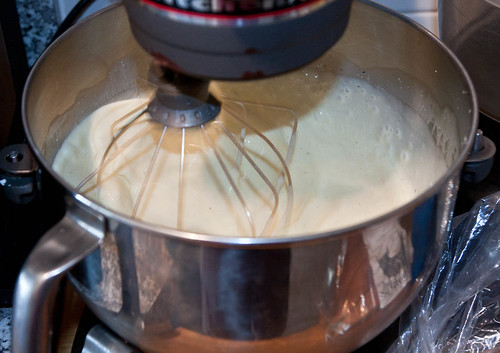
    Yesterday, I took another stab at the pudding cakes, this time with a newly purchased copper bowl, and the texture difference in the cakes with copper was striking.

    If you buy a copper bowl, remember that they almost always come with a coating of laquer (keeps it shiny in the store) that needs to be removed with nasty chemicals and steel wool before you use it the first time.


    2/19/2005

    Homebuilt computer controlled coffee roaster

    Filed under: — adam @ 4:38 pm

    http://home.columbus.rr.com/thegramilas/coffee/roaster.html


    2/18/2005

    You can order a real pizza in Everquest II

    “Real” meaning “physical”, of course. It is, after all, Pizza Hut.

    http://everquest2.station.sony.com/pizza/


    2/3/2005

    Rice to Riches owner busted for huge gambling ring

    Filed under: — adam @ 10:53 pm

    Awesome. I love Rice to Riches! Manmade Mascarpone, baby!

    http://www.nynewsday.com/news/local/crime/ny-bc-ny–gamblingarrests0203feb03,0,467055.story


    Very high tech cookery – watch this guy

    Filed under: — adam @ 8:23 am

    Homaru Cantu makes food with inkjet printers and soon, high powered lasers. Seems like interesting stuff.

    http://www.nytimes.com/2005/02/03/technology/circuits/03chef.html


    How to Cut

    Filed under: — adam @ 7:37 am

    Beautifully illustrated and comprehensive knife skills tutorial for a number of vegetables. Good knife skills are incredibly important – it’s not so much about speed as it is about consistency. When you properly cut the foods you’re preparing, everything is easier – there’s less waste, evenly-sized pieces tend to cook in the same amount of time as each other, and it adds a good amount of important pride to the process.

    http://www.hertzmann.com/articles/2005/fables/

    There’s a lot of other good stuff on the site, too:

    http://www.hertzmann.com


    1/27/2005

    Frying pan roll-up

    Filed under: — adam @ 3:51 pm

    Concept design for a rollable frying pan.

    http://www.designboom.com/contest/view.php?contest_pk=3&item_pk=1211&p=1


    How much milk do you take in your tea?

    Filed under: — adam @ 3:47 pm

    http://www.joshrubin.com/coolhunting/archives/2005/01/128_tea_mugs.html


    1/14/2005

    Pudding cakes

    Filed under: — adam @ 1:02 pm

    This month’s Fine Cooking, my favorite cooking magazine, has an amazing technique / recipe section on pudding cakes. I made them last night, and they’re just divine. The technique is similar to a very liquid souffle, and results in a slight puffed spongy cake gradually merging into a pool of creamy pudding. The recipe was pretty easy to follow, with no serious danger points. Unfamiliar recipe, prep time about 35 minutes, 30 in the oven, and another 30 to cool before popping them in the fridge.

    Definitely follow the suggestion and let them chill overnight. They’re dramatically better cold.


    1/7/2005

    Bed

    Filed under: — adam @ 12:54 pm

    Last night, we were invited for drinks at a preview opening for Bed NY, a new restaurant opening tonight. The space is a pretty impressive loft. The bar is in the middle, flanked by a speckled curved wall onto which video can be projected. A number of bed/dining lounges lined the edges of the room. I was a bit surprised to see the central space largely taken up by a few giant tables instead of keeping with the “dining in bed” motif.
    (more…)


    1/6/2005

    Museum of Food Anomalies

    Filed under: — adam @ 11:43 am

    Not much here yet, but they claim that there’s more coming. I like the spelling potatoes.

    http://www.hanttula.com/exhibits/freakyfood/index.htm


    1/4/2005

    Michael Pollan on why cows should eat grass

    Filed under: — adam @ 11:00 am

    We were having a conversation about “what’s wrong with our food production system”, relating to obesity, the availability of cheap, unhealthy food, the abundance of corn, and eventually corn fed vs. grass fed beef. The question came up about why cows need massive antibiotics doses, and I had remembered reading an article by Michael Pollan describing that it was directly related to the change in diet from grass to grains/corn. I couldn’t find the original (actually, I think it’s buried in the NY Times Magazine archive), but here’s an interview with him that has substantially the same content:

    http://www.pbs.org/wgbh/pages/frontline/shows/meat/interviews/pollan.html


    1/3/2005

    Safe Eggs

    Filed under: — adam @ 1:54 pm

    “Safe Eggs” are eggs that have been briefly pasteurized in the shell. Apparently, they’re indistinguishable in cooking from regular eggs, and safe for raw egg usage with immuno-compromised individuals.

    It seems to me that the salmonella scare is a bit overblown – a lot of people think you’re automatically going to get sick if you eat a raw egg. But, if you have a concern salmonella poisoning or a suppressed immune system, these may be the eggs for you.

    http://www.safeeggs.com/


    12/29/2004

    Vegan-approved condoms

    Filed under: — adam @ 3:08 pm

    http://www.14-condoms.co.uk/condom-styles/vegan-approved-condoms.html


    12/27/2004

    Mobile foodie survival kit

    Filed under: — adam @ 10:07 am

    Awesome.

    It’s a 5×6 little packet with spices and some little sauce bottles for $30. Sadly, they included Tabasco instead of some small batch habanero sauce. But if you care about that, you probably carry your own bottle of that around too.

    http://www.flight001.com/category.htm?viewbyid=11&viewbyitemid=245&step=0


    12/9/2004

    Chef ruins $$$$ truffle

    Filed under: — adam @ 1:02 am

    Aaaaaghhhhhh!

    ‘The arrival of the 850g fungus at Zafferano, the Italian restaurant in London’s Knightsbridge favoured by gourmand glitterati from Madonna to Bill Clinton, drew salivating admirers from Paris and Madrid.

    Queues formed in search of the taste described by Cassini as “earthy, sexy and an aphrodisiac”, available at a cost of R6 600 per micro-sliced sprinkling.

    But then head chef Andy Needham left the mushroom in a refrigerated safe for four days, taking the keys with him on holiday.’

    http://www.iol.co.za/index.php?set_id=1&click_id=29&art_id=vn20041209023205164C780053


    11/29/2004

    General braising technique

    Filed under: — adam @ 3:14 pm

    I originally posted this on Ask Mefi, but it’s worth repeating.

    Here’s my recipe for braised lamb shanks.

    Sprinkle kosher salt over shanks. Pan sear shanks in olive oil until good and brown. Not “just browned”, slightly crispy. Do them in batches if you’ve got a small pan – that’s fine. Lay a bunch of assorted fresh herbs in the bottom of a large pan (any will do, but be sure to include rosemary – it goes particularly well with lamb), and lay the shanks on top. Fill the pan with a mixture of 1/2 wine and 1/2 stock, to halfway cover the shanks. Put in the oven for 1 hour on 350, uncovered (this differs from many braises, which are done in a covered pan). Then add sliced vegetables to the pan (carrots, potatoes, parsnips, mushrooms all work well – use your imagination here). Check every 30 minutes, turn everything when it’s starting to brown and dry out. Add more stock/wine when needed to keep it at the halfway point. Total oven time is probably around 3 hours – it’s done when the vegetables are tender and the meat is falling off the bone. Remove from the oven, and let it cool in some of the liquid. Take the rest out, reserve half. Take the other half, and reduce down a bit, and add some cornstarch or arrowroot which you’ve dissolved in water (this is called a slurry). Stir this in, and let it cook for a few minutes. This will thicken the sauce, which you can add back over the dish and serve . But wait, you’re not done yet! Take the rest of the sauce you reserved, and reduce it over a low flame unil it’s very syrupy (this will be about 1/16th the original volume, but YMWV). This may take an hour. Cool rapidly in an ice bath, and refrigerate. Congratulations! You’ve just made a lamb glace. This is extremely precious (yes, taste it). It will keep in the fridge for a few months. Reconstitute it with boiling water, and use it as part of the stock portion for next time, or for other sauces. Same basic technique works with short ribs.


    11/27/2004

    Tinted carrots offer health benefits, colors

    Filed under: — adam @ 12:05 pm

    Selective breeding yields carrots high in healthy and colorful compounds:

    "Xanthophylls give the yellow carrots their golden hues and have been linked with good eye health. Red carrots contain lycopene, a type of carotene also found in tomatoes that’s believed to guard against heart disease and some cancers.

    Purple carrots owe their color to anthocyanins. In a class all by themselves, these pigments are considered to be powerful antioxidants that can guard the body’s fragile cells from the destructive effects of unstable molecules known as free radicals."

    http://www.sciencedaily.com/releases/2004/11/041122093132.htm


    How to make sushi videos

    Filed under: — adam @ 11:58 am

    http://www.eatsushi.com/demos.asp


    11/18/2004

    Wild mushroom strudel

    Filed under: — adam @ 11:27 am

    This follows my general rule of “if you’re trying to impress, use phyllo dough or puff pastry, because people who haven’t worked with it think it’s hard and it’s not”.

    The basic strudel is really easy – saute a handful of shallots and a chopped garlic clove in 2 tbsp butter until they turn clear. Add 1 cup chopped mixed mushrooms* and 3 tbsp white wine. Cook until they’re cooked through – 8-10 minutes. Cool. Mix 1/4 cup crumbled goat cheese and whatever fresh chopped herbs you have on hand (I like parsley**). This is your filling. Thaw phyllo dough according to the directions on the package (it comes frozen). You’ll need 3 sheets. Lay out 1 sheet, brush with melted butter. Lay another sheet on top of it, and brush with melted butter. Repeat with the third sheet. (So now you have a stack of three sheets, with melted butter on each layer). Put the filling in the middle, and roll it up like a burrito. Brush the entire outside, top and bottom, with melted butter. Lay it seam side down on a pan or baking sheet with sides (not a perfectly flat sheet), seam down. Cut a diamond pattern into the top with parallel diagonal cuts (use a sharp knife, otherwise you’ll tear the dough). Bake at 400 for 20 minutes or so, until golden brown. Slice and serve.

    * Whatever mushrooms you can find. Definitely choose cremini over white button. Shitake adds some nice chewy texture.

    ** Parsley is ALWAYS ALWAYS ALWAYS flat Italian parsley, not the crinkly stuff.


    11/10/2004

    Obsession, by Ronald McDonald

    Filed under: — adam @ 1:57 pm

    McDonald’s Japan discovers the tomato, or something.

    http://www.mcdonalds.co.jp/sales/cmlib/


    10/26/2004

    The Tasting Room gets a little big for itself

    Filed under: — adam @ 4:27 pm

    I trust the Zagat ratings less and less as time goes by. The Tasting Room is good, and it’s certainly cozy (that’s code for “one too many tables packed into this tiny space but you have to forgive them because running a restaurant in NYC is really hard”). I enjoyed my meal there a lot, but it really didn’t take my breath away, and I can’t say that I think they deserve such a high rating. Granted, they aim high. But if you’re going to serve foie gras, you’re going up against some masters. It goes without saying that the foie gras at Per Se was better, but that’s not really a fair comparison. But in the same price range, I preferred the foie gras at Le Jardin Bistro.

    The Hot Plate : Just a Taste
    http://www.typepad.com/t/trackback/1321918


    10/17/2004

    The perfect corn bread recipe

    Filed under: — adam @ 4:55 pm

    I found this on the internet, but it’s gone now. Luckily, I printed out a copy, and supplemented it with my notes. I think this is the best corn bread I’ve ever had. Here it is:

    3/4 cup oil (I use grapeseed)
    1 1/4 cup sugar
    3 large eggs
    1 cup soured milk (add 1 tbsp lemon juice to a measuring cup, fill
    with milk to 1 cup, let stand for a few minutes)
    1/2 tsp. vanilla
    2 tsp. lemon zest, finely minced
    1 tsp. kosher salt
    2 1/2 tsp. baking powder
    1/2 tsp. baking soda

    1 1/2 cups ap flour
    1 cup corn meal

    Preheat oven to 425F.

    Oil a 10″ cast iron skillet (not the 3/4 cup, use a little extra). Line bottom with 2 layers of parchment. ( These are helpful: http://fantes.com/pan_liners.htm#circle ).

    Do the following with a mixer on low (I use a kitchenaid on 2-4):

    Blend oil and sugar together. Mix in eggs, sour milk, vanilla, and lemon zest. Fold in salt, baking powder, baking soda, flour, and corn meal. Pour batter into skillet. Bake until edges are lightly browned and top is just firm (it may crack), and springs back when touched. In my experience, this is typically around 25 minutes. On occasion, I’ve missed the timer and let this go for longer and the outside burned a bit (dark brown, not black). This, surprisingly, didn’t ruin it.

    Enjoy!


    Escher tomatoes!

    Filed under: — adam @ 1:20 pm

    This person bit into a tomato, to find that all of the seeds inside
    had sprouted little tomato plants. Trippy!

    http://www.cookingforengineers.com/2004/10/off-topic-surprises-in-snacks.html


    Powered by WordPress